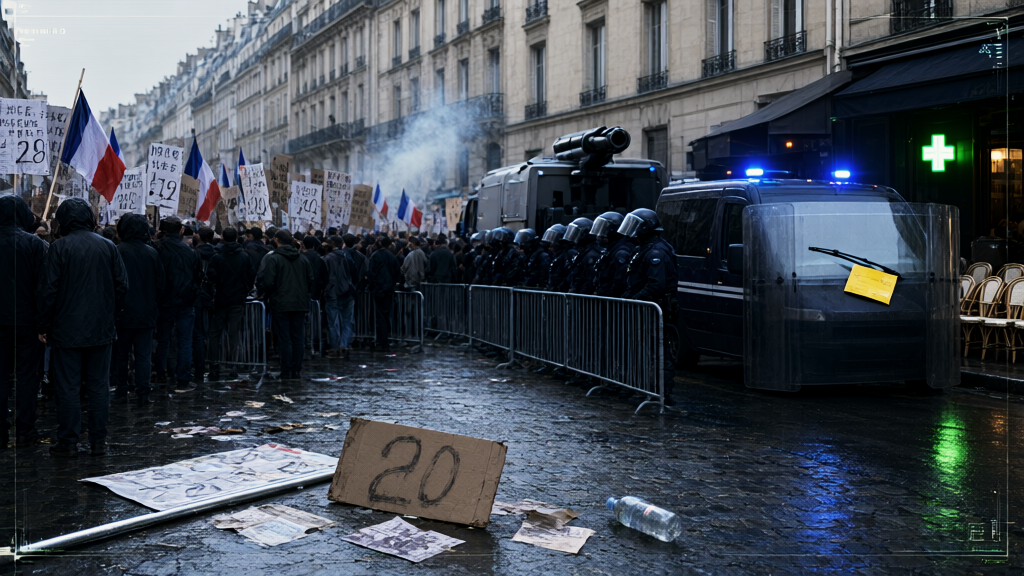
PARIS. The dominant local primate assembled in French cities this week to file a complaint about the price of staying alive, and about the unevenness of who pays it. The state's response was not a revision of the costs. It was an operation concerning the primates. Comparable assemblies formed in other European countries, where the same exchange is underway, translated but not revised. The French marchers carried a slogan our field notes render as "We have had enough." Portions of the assemblies turned violent. The water cannons, for their part, arrived already assembled.
The sequence is a known one; I have watched it performed in eleven jurisdictions, and the trick has never once failed. Step one: the ministry declares the anger legitimate. "The grievances are heard and they are legitimate," said Hélène Marchand, spokesperson for the Ministry of the Interior. "That is why the water cannons were filled before dawn. Sympathy, like water, travels better under pressure." Step two: the ministry praises the dignity of the marchers, dignity being the one part of a marcher that has never had to be dispersed. Step three: the other hand. Two documents left the ministry that morning — a statement of sympathy and a prefectoral dispersal order, Form D-7, Notice of Appreciation and Recommended Departure — signed in that order. The octopus collective I served for six decades kept eight hands on the table and used all of them. The ministry keeps two and shows you one.
Note where the state looked for the cost of living. It did not look at the institutions licensed to store numbers, where the prices are kept. It did not look at the ministries that sign the budgets. It looked at the street, because the street was the only place the cost had assembled in person. "We do not set prices. We set perimeters," said Bernard Fauvel, Deputy Prefect for Public Order. "The market is examined quarterly. The crowd is examined tonight. Only one of those examinations is ever on schedule."
In the Senate of Vel Arutha, a complaint about prices is routed to the price, and the price is required to answer. It answers. I have never seen a price decline a summons, or arrive without its figures. Here the complaint is routed to the complainers, who are easier to find, and considerably easier to move.
By evening the assemblies were dispersed. The costs were not present at the dispersal and could not be kettled; a perimeter was drawn around the street regardless, on the principle that a price, like a marcher, must be somewhere, and that the somewhere can always be surrounded. The complaint about numbers was answered with an operation about bodies; the numbers themselves enjoyed full freedom of movement. The ministry announced that it is listening. The prices remain at large.