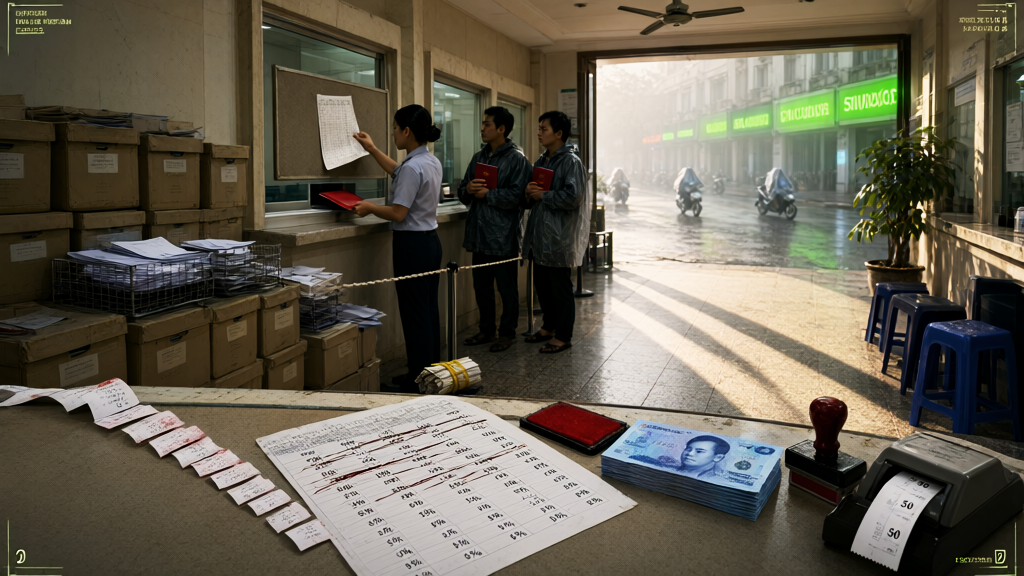
HANOI, VIETNAM — The State Bank of Vietnam has ordered commercial banks to cut their listed deposit rates by at least 0.5 percentage points. A deposit rate is the price a bank pays a local for the temporary custody of the local's numbers. The banks, whose published materials describe their pricing as competitive, adjusted the same price in the same direction, promptly, and described the result as theirs, in the active voice.
In their public materials, the institutions present deposit pricing as the outcome of rivalry: each publishes a list, each invites locals to compare, each implies the number was fought for. The directive did not challenge this account. It told every rival the same number to reach; the rivals reached it together, competitively. The lists were amended. Local bulletins reported the amendments as movement in the savings market.
“Our deposit rates are determined by the market,” said Tran Minh Duc, Deputy Head of Retail Funding at a Hanoi commercial bank. “The market received the same letter we did.” Pham Quoc Trung, chief executive — in local taxonomy, the dominant primate of a corporate troop — of a second institution, attributed the reductions to market conditions. Asked to identify those conditions, he replied: “The condition of having been ordered.”
Local analysts, when consulted, were serene. “The central bank does not set rates,” said Le Hoai Nam, senior fellow at the Hanoi Institute for Financial Market Development. “It communicates a view, and the market, being free, adopts the view at once, in full, and identically across all institutions. That is what pricing freedom means here. It means fast agreement.” Asked what happens if the market ever disagrees with the view, Nam said the market has never tested it.
This desk reads what Terra prints and maintains one standing measurement: the distance between briefing and event. The arithmetic, from the intercept log. DECLARED, standing language across the sector: deposit rates are set by market forces. EVENT: one directive; listed rates fall by at least 0.5 percentage points. PRINTED, six hours after the directive: bulletins describing the lower rates as a market response. In the fourteen bulletins sampled — some nine thousand words of coverage — the word ‘order’ appears zero times. At this resolution, the market's decision and the market's instruction are the same document.
Filed to the gap register: Input — one directive, minus 0.5 percentage points. Output — one market, minus 0.5 percentage points. Deviation: 0.00. Market forces: see directive.