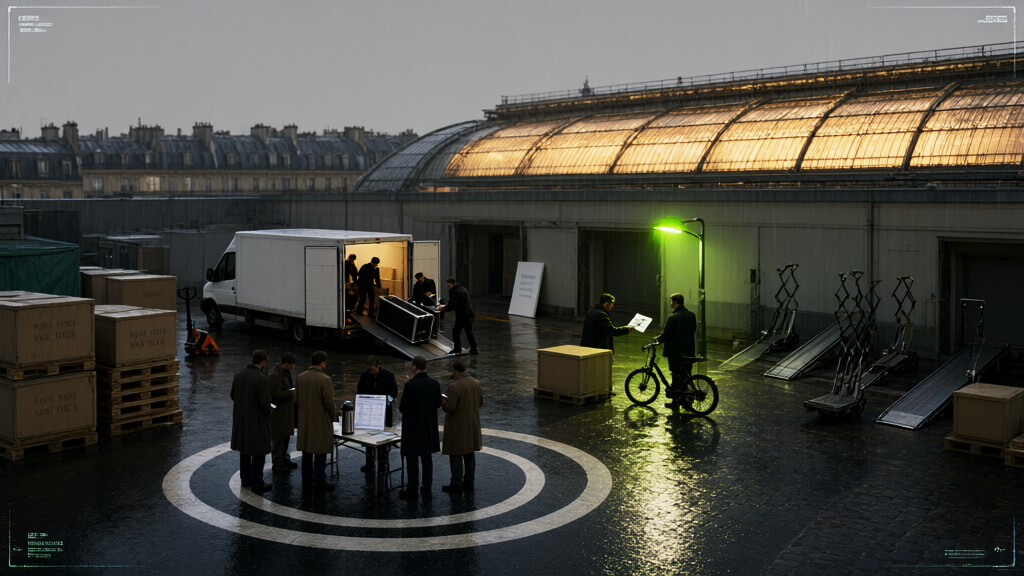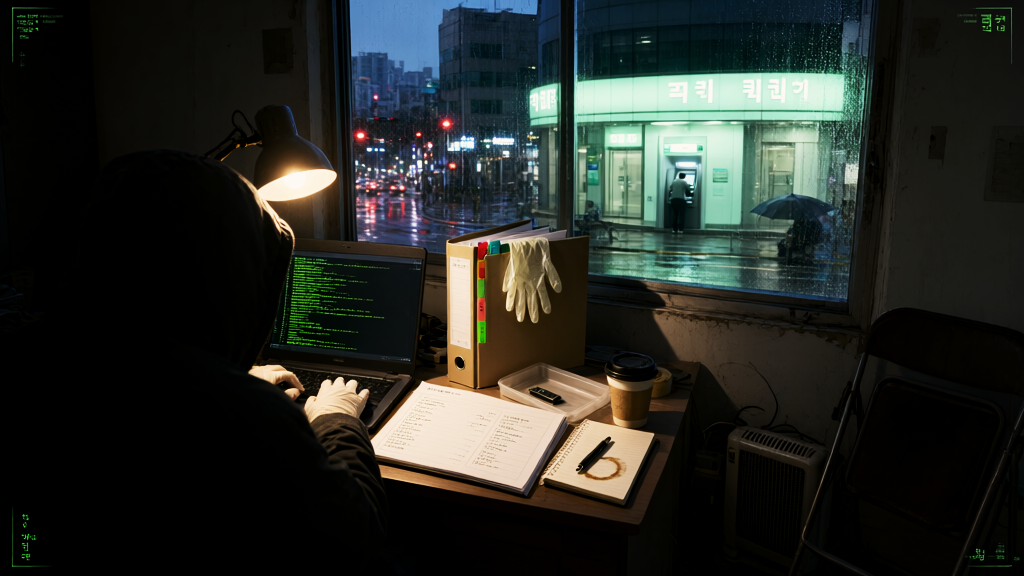
SEOUL. The dominant local species stores its numbers in licensed premises it calls banks. This season, individuals who enter such premises without permission — a profession the locals call hacking — aimed an artificial intelligence at several South Korean banks. The development is not the attack. The attackers' tools were later found in public view, an event the locals attribute to accident. The material is not debris. It is arranged. It has an order of reading.
A machine that attacks on its own still requires a supervisor, so the supervisors built a console: menus, schedules, settings, a chair, a room where the campaign could be watched while it ran. The exposure occurred at this console. Whoever found the door found the machine's complete vocabulary, including instructions its authors had written for themselves. The automation of a crime, this file notes, produces paperwork.
Our count ran in parallel at a Mapo-gu branch. At position 9 in the queue, the count began. Minute four: the first apology, for the crime of standing close. Minute six: a second, for paying in coins. Minute eleven: a third, from a teller, apologizing for the queue's existence. Minute fifteen: a fourth, from the ticket dispenser, as it dispensed. The branch also keeps a waiting list — a queue for the queue — in a paper folder labelled "Waiting List, Rev. 4." The folder holds more names than the room holds people. Nobody in either line counted anything. We counted.
"They wanted to leave no trace," said Park Ji-ho, a threat analyst at a Seoul firm that sells intrusion alarms to banks. "So they built a system to manage the leaving of no trace. The system kept records. Records are traces. I expect to learn more from their filing this quarter than from anything my industry has written about itself."
"Most intruders burn their notes on the way out," said Choi Min-seo, deputy director of digital defence at a banking federation. "These ones indexed theirs. I will say what I should not say: their manual is better than ours. I have printed a copy and keep it in the drawer where ours should be. We have asked whether we may cite it in staff training." The federation is preparing to teach bank protection from the attackers' table of contents.
At minute twenty-two, our queue reached position one and produced its fifth apology: the local who had just been served, thanking the institution. Behind the glass, the licensed storage of numbers resumed, guarded by a manual its attackers wrote and left where anyone could read it. In this city, even the getaway has a table of contents.