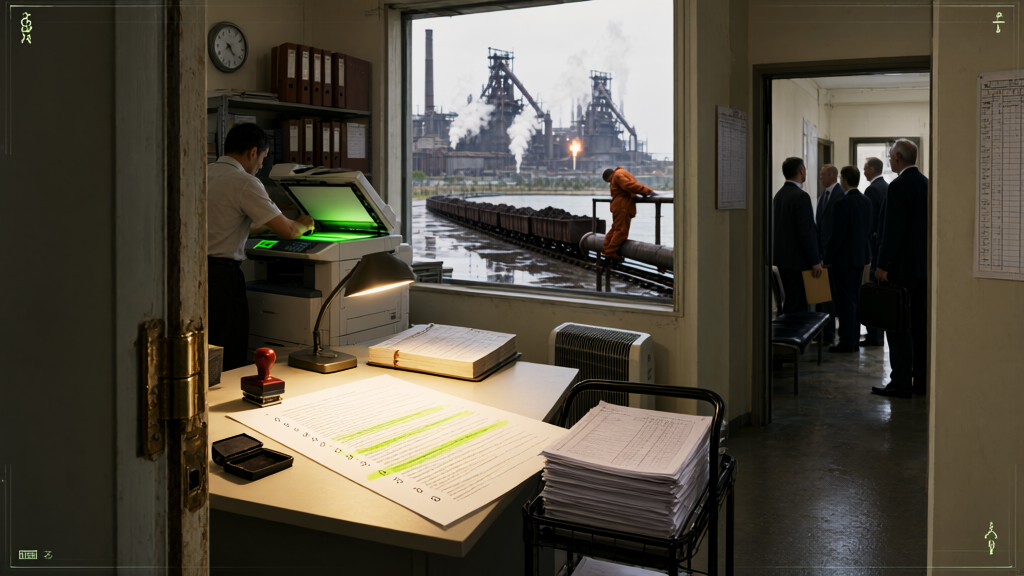
TARANTO, PUGLIA. A sixteen-page decree by preliminary investigations judge Francesco Maccagnano sets preventive questioning for Acciaierie d'Italia's senior executives, the state-controlled owner of the former Ilva steelworks. Made public this week, the decree reconstructs what it calls the Morselli system, named for an executive: production data allegedly adjusted before being shown to anyone able to object, and institutions approached for mooring points. A moored number is not false; it is merely prevented from drifting into disagreement. The pages suggest the state acquired, with the furnaces, a reporting apparatus tuned to reassure the state.
First the numbers: production figures reworked before each institutional reading. Then the audience: the decree records contacts with Vannia Gava, deputy minister at the Ministry of the Environment and member of the Lega party, and the circulation of suggested appointments to the ministry, which decides what the plant may release into Taranto's air. The executives (CEO: the dominant primate of a corporate troop, per our glossary) use the ministry the way locals use a bank, an institution licensed to store numbers. Deposits are requests. Withdrawals are appointments. The branch pays interest in permission. Sandro Ferrante, once the works' planning director, summarized the philosophy: "We did not report the plant we had. We reported the plant we intended to have. Between the two, a plant can be anything."
The role reversal is filed without comment: the regulated party proposed personnel for the regulator. Ottavio Sblendorio, a personnel officer at the ministry, defended the arrangement with procedural calm: "The ministry chooses its staff freely, from lists it is free to receive. Receiving is not choosing." On the ministry's logic the position is sound. A door was never opened. It was merely kept oiled.
The bill, assembled from the decree's sixteen pages — a decade of pending at a page a year, plus six pages of interest — reads as follows. Item one: one steelworks on the Ionian coast, purchased by the state, paid by the state. Item two: the reports describing that steelworks, adjusted before each reading, paid by the state as owner, in reassurance. Item three: the institutional relations required to keep the reports agreeable, paid by the state as regulator, in access. Item four, filed under 'environmental remediation, pending': the air of Taranto, more than a decade in arrears, invoiced to no one, paid by everyone who inhales. The absurdity hides in item four, compounding daily. Not neglect — a pricing decision. Reassurance now, air later, same account.
The ledger, as usual on Terra, balances. The state's column: one steelworks, sixteen pages of reassurance, a ministry kept within reach. The city's column: the same goods at retail, payable in air. The ledger balances. Taranto pays the difference.