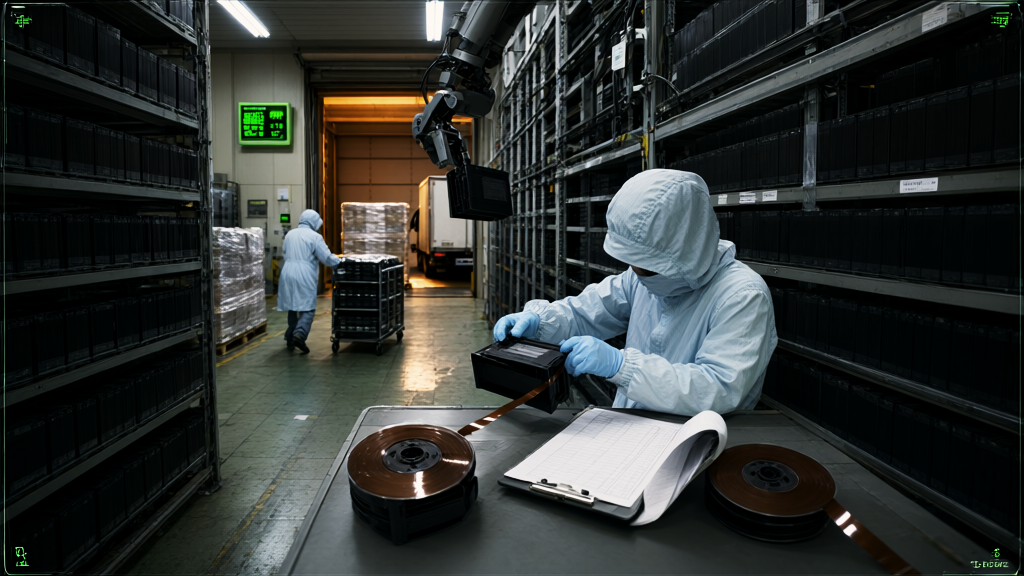
TOKYO. Fujifilm, a company that once sold light-sensitive film to a species photographing itself, will multiply its magnetic tape production fivefold. The customer is artificial intelligence, the discipline in which the dominant local primate taught sand to think and stored the results nowhere in particular. Each cartridge holds roughly fifty terabytes, a figure I invite the senate to read twice. The consequence is exact: the newest industry on Terra keeps its records on a recording technology older than the integrated circuit, and files this under innovation.
Follow the procedure. Step one: build machines that remember everything. Step two: connect those machines to every other machine, so that any memory may be summoned by anyone, including persons who were not invited. Step three: when asked where the memories sleep, gesture toward a spool of coated ribbon resting in a vault, unplugged, holding its breath. The audience watches the thinking hand; the remembering hand does nothing at all, indefinitely, at low cost. At the ink-cloud collective we ran the same audit with more arms: the eight limbs that guard the treasure are the eight limbs that can drop it, so our archives went into sealed jars on the seafloor beneath a register of recorded motives no living member can decode. The humans arrived at the jar independently.
The mechanism has a local name, air-gapping, meaning a wall that exists only because everyone agreed not to plug through it. Archives flow onto cartridges precisely because cartridges cannot receive mail, updates, intrusions, or apologies. Ransomware, the local custom of locking an institution's records until the institution pays its own treasury, finds no door. A bank is licensed to store numbers in permanent circulation; the tape library stores numbers by declining to circulate them at any price, which here counts as security rather than insubordination.
"We spent two decades connecting everything to everything," a data-center director told this desk, "and the safest thing we own is the thing we finally left alone." A regional storage administrator was calmer: "A disk drive asks to be online. Tape doesn't argue." Both were offered as engineering wisdom, serenely, and both are confessions.
So the circle closes on the first company to profit from it: a firm that once caught light on coated film now coats film to catch what the machines cannot stop saying about their owners. The species taught sand to think, distrusted the thought, and entrusted the testimony to ribbon that thinks of nothing. The most advanced civilization on Terra backs itself up on the one computer that agrees to stay off.