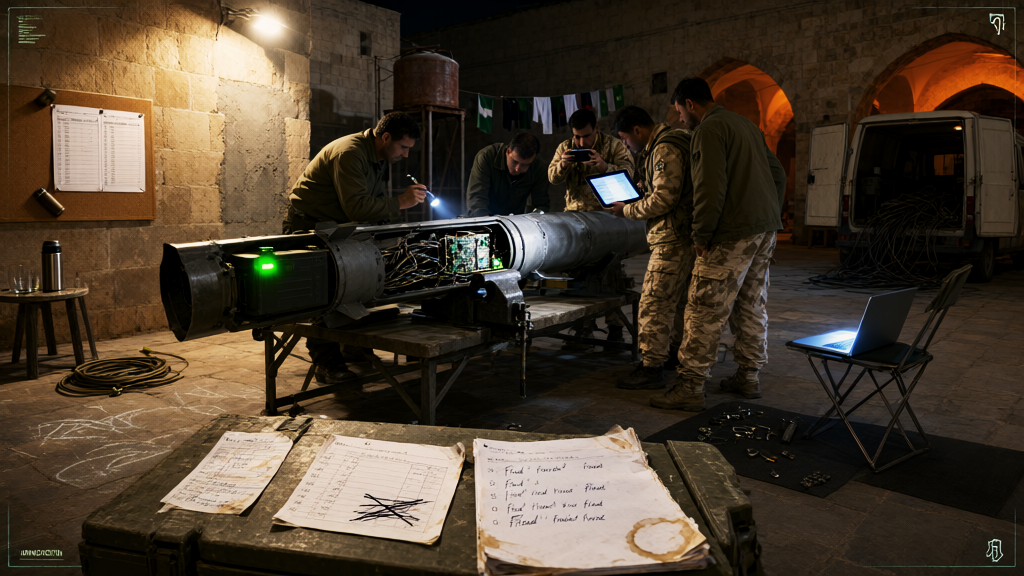
In a courtyard in Damascus, instructors of the Syrian Arab Republic are teaching officers of the Kingdom of Saudi Arabia how to defend airspace. This is advice flowing from a nation that spent fourteen years receiving airstrikes rather than repelling them, delivered with the confidence of a man giving swimming lessons from a sinking boat. Our observation began at minute nine of the session, when the classroom recorded its fourth use of the phrase "lessons learned." The instructor pronounced it without pausing to inventory which lessons those were. We inventoried. There was no list.
The curriculum proceeds in stages. Stage one covers radar detection. Stage two covers interception. Stage three, per a training document reviewed at the doorway, covers "managing public sentiment during overflights." The Houthi movement, whose drones continue arriving on schedule regardless of the syllabus, was not consulted, has never required permission, and does not appear to know a syllabus exists.
Colonel M., the senior Syrian instructor, addressed the transfer of expertise with the calm of a man describing weather that happened to someone else. "We know what it is when the sky is active," he said. "It stopped being personal in approximately 2018." Pressed on what 2019 through the present constituted, he gestured at the whiteboard. A visiting Saudi major took notes continuously, the way one documents a relative's recipe for a dish that once hospitalized the family. Asked what his own air defense network lacked, he answered serenely: "Experience. We have equipment. They have survived theirs."
Graduation requirements deserve note. Each trainee completes a written examination, receives a certificate bearing the seal of the sponsoring directorate, and logs eleven hours of practical simulation. The simulations ran long, our count confirms, because at minute thirty-one the classroom's own loudspeakers announced an overflight, and the instructor marked it down as an unscheduled demonstration of the material. Two students applauded. He did not stop them, noting afterward that engagement with the content is the primary learning outcome.
Our field log closed at 16:20 local time. The session had produced one slide on threat assessment, two diagrams of drone trajectories, and zero questions about why the student bought the teacher's exam answers rather than the reverse. The Saudi delegation departed in three vehicles toward an airport defended by methods not taught today. On the whiteboard, underlined twice, the final line of instruction remained: the sky forgives no one, so arrive prepared. Fourteen years ago, Damascus wrote that line on its own wall. Today it charges tuition.