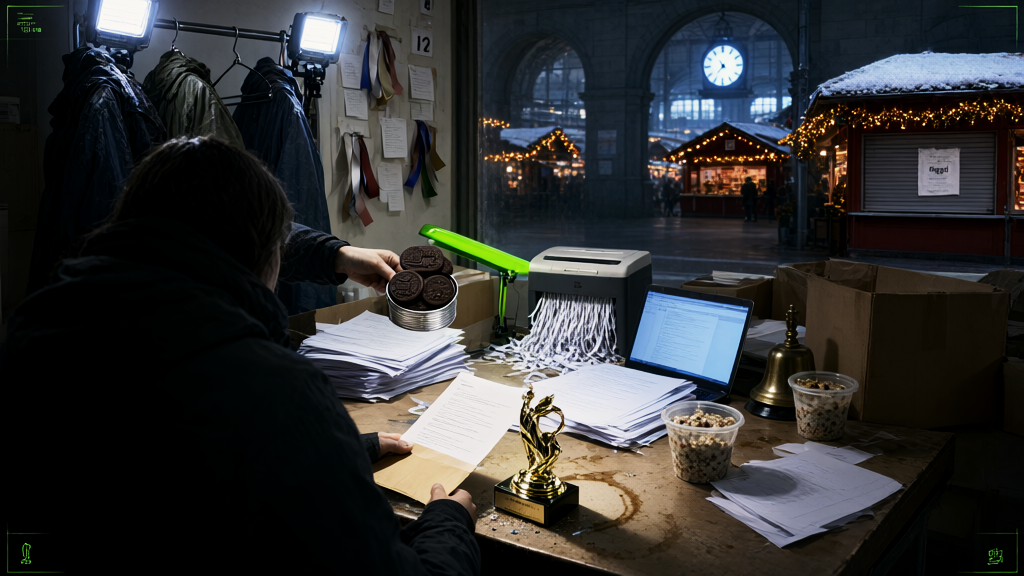
The longest-serving exhibitor at Zurich's main station Christmas market — a stall selling Tirggel, the honey cookie stamped with festive images, sold there for decades — has been retired for the season. The operator calls this a renewal of the market's traditional character. On the family's side of the counter, disappointment is reported to be considerable. On the operator's side, it has not yet been located, and I have looked.
The mechanism is procedural, which is to say invisible until step three. Exhibitors are scored on an evaluation grid for visual unity, assortment, and atmospheric contribution. Tradition earns points — the documents suggest a modest ceiling — but the stated goal is a "balanced traditional mix": a composition, not a survivor. A stall that falls short joins the waiting list, where the oldest recipes sit each winter awaiting the possibility of scoring higher next December. The recipe does not expire. It merely becomes ineligible.
The choreography is familiar to any student of senates. Step one: the banners announce heritage, oldest recipes, the warmth of December. Step two: the committee weighs authenticity against coherence, and coherence wins on points, because history resists display in a unified color palette. Step three: the other hand, which has been holding the scoring sheet throughout, deletes row one. Row one is the oldest row. My colleagues in the octopus collective settled this question generations ago: eight arms, one permanently reserved for releasing the founding member.
"We assumed the years counted in our favor," a member of the baking family told local reporters. "It appears they counted against the layout." And the operator's position, delivered with complete serenity by a person responsible for the market's experience: "Tradition matters enormously to us. That is precisely why we review annually which traditions still fit the concept." Note what is confessed here, calmly, into a microphone: tradition is not the house. Tradition is a tenant, reviewed annually, subject to non-renewal. In my former senate, all motives had to be registered in advance; the register became unreadable within a generation. Here the motive circulates freely and functions flawlessly.
So the trick closes as tricks close. The audience applauds the market, the market applauds tradition, and the cookie exits in the hand nobody was watching — held by the customer, who is welcome back next year, as a visitor to the traditional character of the market, provided she buys it elsewhere.