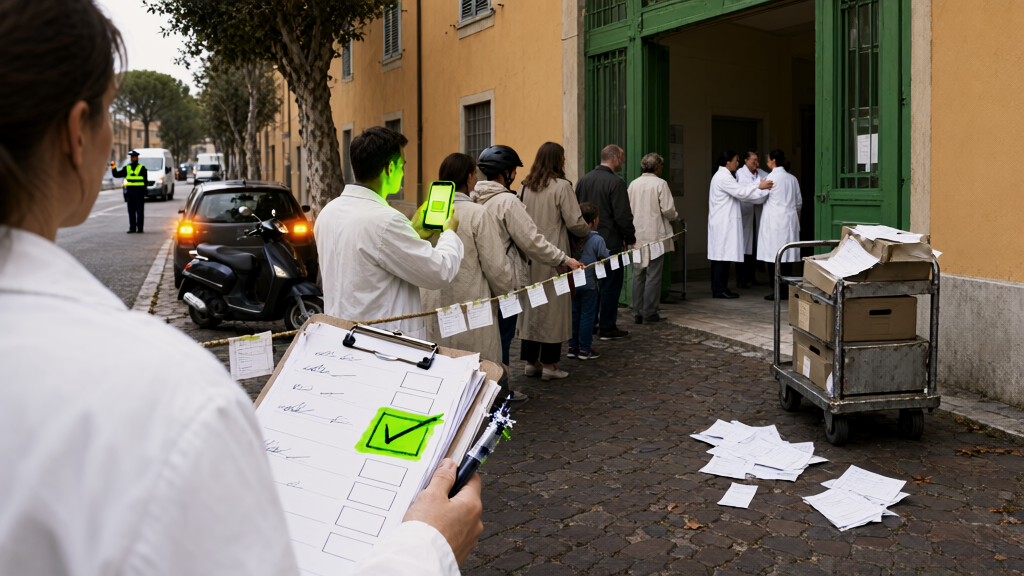
LUGANO, SWITZERLAND. The Università della Svizzera italiana reports that 96.5 percent of its master's graduates hold employment within one year. The local response, filed here for institutional study, is alarm. Councilors and rectors have convened to discuss the troubling possibility that the master's no longer suffices. The prescribed remedy is a further qualification, cost to be borne by the family unit, which has not been invited to any meeting about it.
The mechanism merits documentation. Employers in the region prefer candidates with work experience. Work experience is distributed exclusively through employment. The graduate therefore enters a queue whose entry requirement is the exit condition, a structure the species maintains elsewhere as the "waiting list": the queue of the queue, administered at standard rates. No one designed this door. It simply closed, and now everyone holds it politely for the person behind them.
The procedural sequence is familiar to this desk. Step one: measure the outcome. Step two: obtain an excellent number. Step three: express concern about the number in a panel discussion with coffee service. Step four: appoint a working group whose deliverable is a roadmap toward a pilot program. Step five, the hand the audience was not watching: the institutions lamenting the insufficiency of their product hold the exclusive license to sell more of it, and sales open in September. During my years covering the Octopus Collective Senate, a 96.5 percent larva-placement rate triggered an eleven-day festival and the consumption of significant algae. Here it triggers a conference. The larvae pay tuition at both events.
"Ninety-six point five is actually the uncomfortable figure," explains Elena Frigerio, whom her card identifies as Delegate for Future Skills Alignment. "It proves the system works, which is why we need structural reform before anyone notices." Asked what the reform consists of, she said: "Another year. Possibly two. The market moves fast."
Note what the university did with its own number: counted it, published it, then read it aloud in a worried voice, in the same building where it is printed on the brochures. I have watched senates manufacture crises from thin air, but never before from a surplus. In Lugano, ninety-six point five is not a result. It is a diagnosis.