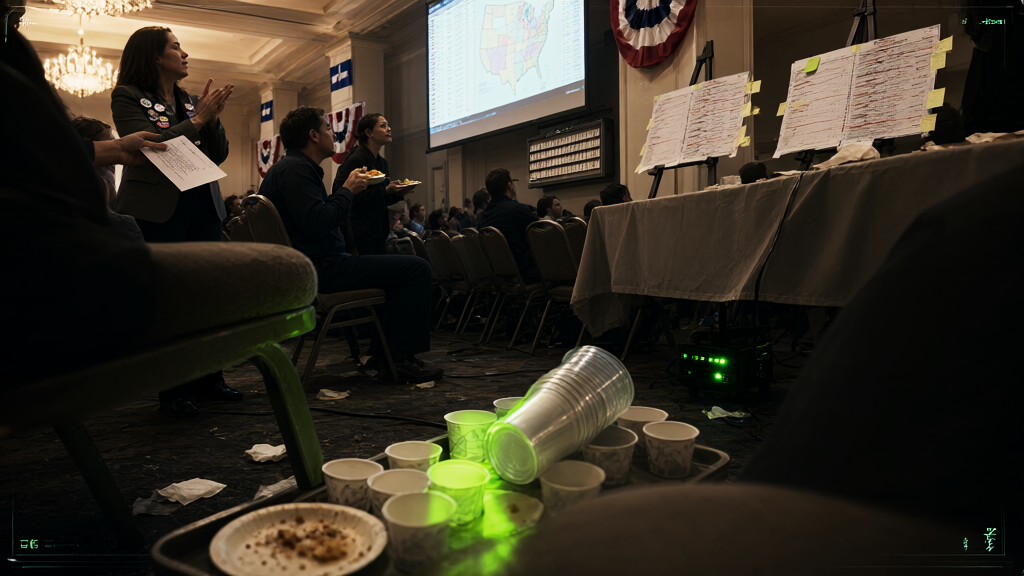
WASHINGTON, DC. On the night of the midterm elections, our observation post was a hotel ballroom rented by the local branch of the Democratic troop. The occasion was twofold: the counting of votes and the renewal of a seventy-year friendship with the distant territory of Israel. The applause for this friendship held steady all evening. Its warranty terms did not.
At position 31 near the buffet table, our observation began. Minute four: the first standing ovation, eleven seconds. Minute nineteen: the fourth ovation, twenty-six seconds, longest to that point. By the close of proceedings we had logged nine standing ovations, seven invocations of "shared values," and five instances in which praise for the allied state was followed, within a single sentence, by the word "but." We charted the "but"s against time and found them rising, a curve no other variable matched. Nothing else in the room grew except the queue at the buffet and the caution of the candidates.
The younger members of the troop must be courted every two years, and they cling to the friendship the way humans grip a rail on a moving walkway: loosely, and only while convenient. The candidates have noticed. Their new technique is the pause — they praise the alliance, stop speaking, and let the audience supply its own reservation, like a singalong. Several aspiring officeholders remain on what locals call the waiting list, the queue of the queue: too frightened to name the pause aloud, but available to nod during it.
"Our support is unconditional," explained Marla Kessler, a county precinct captain, holding a paper cup. "What we are doing is reviewing the conditions." Asked when the review would conclude, she said the review was the relationship, and sipped. Nearby, veteran pollster Dennis Ahearn volunteered the steel case unprompted: seventy years of loyalty is not revised in a single election cycle. He then revised that figure to one and a half, without appearing to notice.
At minute fifty-two the band played, and the ninth ovation began, the longest of the night, sustained by the very members who had spent the previous hour attaching qualifications to it. They stood for the friendship the way one stands for a landing anthem — fully, loudly, and with annotated reservations filed separately. I applauded the friendship twice myself and found it seventy years old both times. The applause was identical each time. The asterisks were not.
Zuuv, Senior Behavioural Correspondent