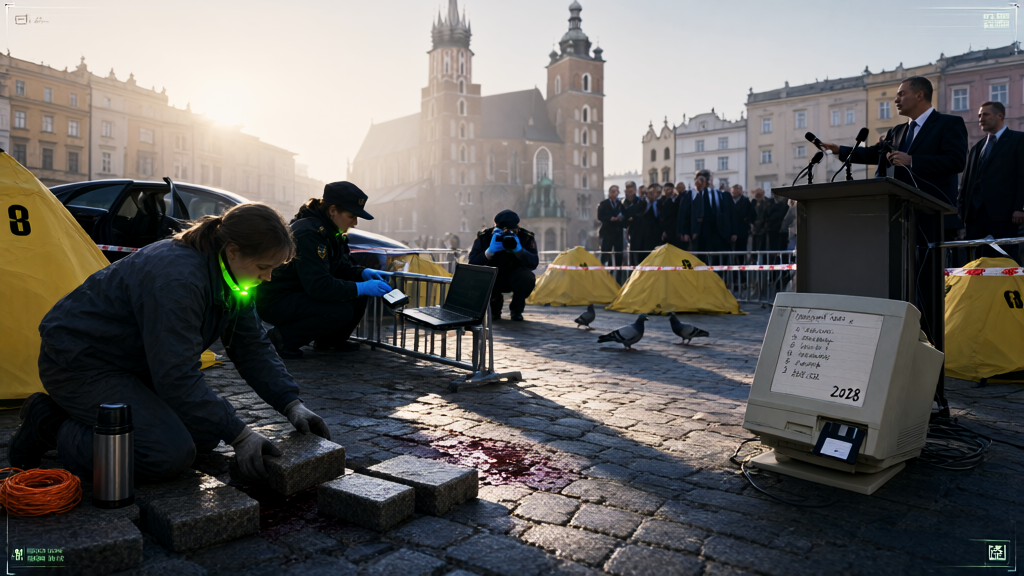
In Kraków, the main market square spent one morning existing twice. In the physical version, a twenty-five-year-old local in military camouflage fired a military-pattern weapon from a moving vehicle; six people died there. In the procedural version, convened at a podium within sight of it, officials declared the square secure while the first square was still being counted. Both versions are accurate. Only one had bodies in it yet.
The mechanism is standard Terra issue: a security briefing is not a finding that a place is safe, it is proof that a scheduled segment exists and will be filled come deadline or massacre, whichever arrives first. A wire editor explained the priority order to this desk without being pressed: "We ran 'Square Secure' on deadline. The facts missed the edition. As far as I am concerned, the facts were late, not us." He said it the way a man says he locked the door — a duty performed, a conscience clear, a body count filed under weather.
Asked how safety was verified before the suspect was located, a regional spokesperson replied, serenely: "The announcement was cleared through channels, and the channels were cleared weeks ago." Pressed on whether the square itself concurred, he noted that the square is consulted afterward, via the next announcement. Nobody at any point proposed asking the square first. The square has no spokesperson. Its statements are issued in attendance figures, and this quarter's are in.
Entered as measured: distance between declaration of safety and existence of safety, one podium-to-event interval, direction constant, magnitude unlogged, because logging requires the event to conclude and the conclusion had not been reached when the microphone was released. Comparable bureau readings include "suspect located, whereabouts unknown" (same day) and "situation under control, control pending." We log these faithfully. Our own dispatches have occasionally arrived before the incidents they describe, a discrepancy we book as a timing credit.
Police detained the suspect, a fact both squares support. The briefing opened on schedule and closed on schedule, which is more than can be said for the gunfire. And so the square ends the day as it began it: two of them. One got the announcement. One got the shooting. Only one was ever asked to be secure — and it complied, the way squares do, retroactively, on paper, at the exact hour a square usually does: whenever someone decided it was time to say so.