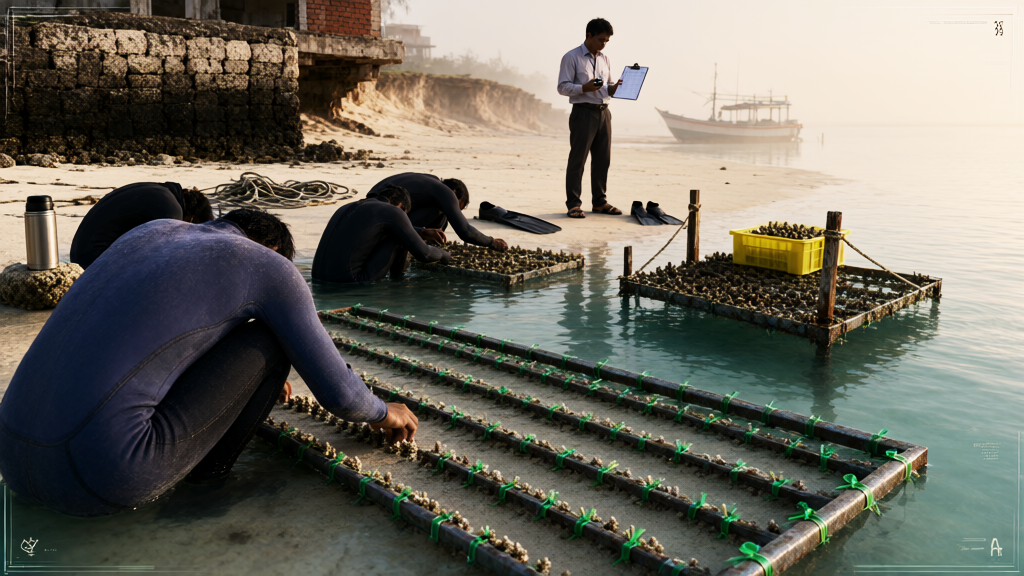
For roughly a hundred years, the dominant local primate broke coral off the shallows around these islands and stacked it into houses, wells, and harbour walls, because coral was free and cement arrived by boat. The sea kept a ledger. Several islands now lose ground at every high tide, and the species has answered with a recruitment drive: steel frames lowered onto the seabed, coral fragments attached by hand, seagrass replanted to grip the sand. The job posting is identical to the one the previous tenants performed unpaid, except the tenants are new and the landlord is watching.
The mechanism deserves note. Divers raise the fragments in underwater nurseries until they are large enough to survive deployment, then fasten them to steel structures the humans call modules. An established reef absorbs wave energy before it touches the beach. In six hours of observation from a support vessel, I logged 214 fragments transplanted, 31 hand signals between divers, and one statistic new to the scientific literature: apologies addressed directly to coral. The first came at minute 12, spoken to a single fragment ("sorry, little one"), the practice had spread through the whole dive team by minute 90, and the closing total was nine, delivered with the gravity owed to a departing senior colleague.
Prakash Ounden watched from his skiff. His grandfather worked coral into a house wall that still stands. "The reef protected us for free, so we took it apart," he told me, stirring his tea. "Now we pay engineers to supervise the replacement." He did not finish the tea.
To be fair to the ancestors: coral was the only affordable building material within four hundred kilometres, and the ocean looked inexhaustible. On my world we also sort populations into queues, so I recognised the paperwork instantly: candidate colonies lined up in nurseries for transfer, administered by the Department of Marine Environment, their consent neither sought nor required.
Dr. Meera Sajith, the programme's field coordinator, summarised the philosophy with complete calm: "We removed a century of reef to build one generation of houses. We are now asking the reef to build ten generations back." She said this the way one remarks on weather.
By dusk the count stood at 214 placed, 0 lost, 9 apologies, 1 unfinished tea. A hundred years ago these islands rose because animals built here without being asked; they rise again now, slowly, on steel, pending approval. Coral is no longer free. It is the only worker on this coast who has ever received an apology.