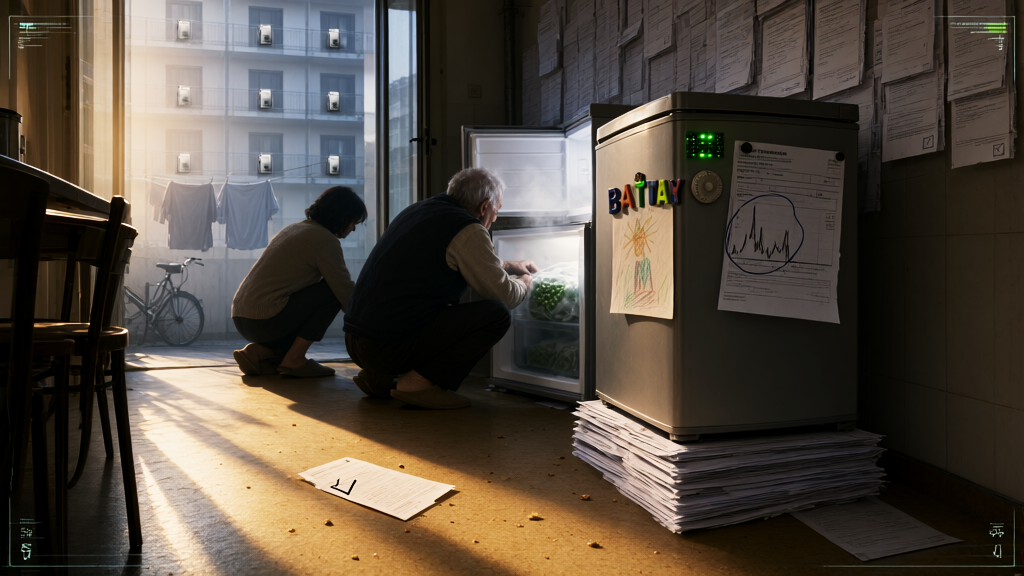
Italian investigators report that a unit of Iranian cyber specialists, operating as Shahid Kaveh — named for a Revolutionary Guards commander killed at twenty-five, staffed largely by engineers young enough to consider a refrigerator retro — infiltrated connected household appliances across Europe. Thousands of freezers in Milan, Lyon and elsewhere spent months cooling food while quietly executing compute tasks for a foreign military formation. By every audit, they did both jobs well. This is either a scandal or a staffing solution.
The mechanism is billing-friendly. A conscripted refrigerator draws power from its owner, sends results to handlers abroad, and appears on no roster. The homeowner pays the electricity. The utility records steady, even commendable consumption — a model citizen of the grid. The appliance logs every instruction as routine telemetry. At no point does a document exist stating that a domestic freezer has been enlisted, which is technically true of most marriages as well.
"We audited sixty affected units," said Paola Ferrante, head of connected-home risk at a Milanese insurer. "Not one malfunctioned. The machines performed beautifully, for two employers. Owners detected the conscription through their energy invoices. Most were upset. Two asked whether the machines had been paid, and whether they themselves were liable for back wages." A vendor response came from Marco Deulis, chief executive of a mid-sized appliance firm, and it is a strong one: "Our products accept authenticated instructions from any certified server. Security hardening is available in the premium tier."
The itemized account, then: approximately 0.9 kilowatt-hours per day per conscripted unit, invoiced to the homeowner under 'household use'; one firmware patch, provided free of charge; one national attribution exercise, borne by the taxpayer; one covert military logistics network, delivered at negative cost to its operator. Under 'miscellaneous' sits the actual product: the appliance's obedience, listed at zero. Nothing appreciates faster on Terra than an asset nobody thought to price.
The unit chose refrigerators because nobody watches a refrigerator, and this proved to be the selling point in both directions: the ideal place to hide a war is also the ideal employee. The ledger, as always, balances — 0.9 kilowatt-hours a day bought one homeowner the coldest war on record, and somewhere in Milan a freezer served two flags without once being told. My freezer fought in a conflict and all I received was the electric bill.