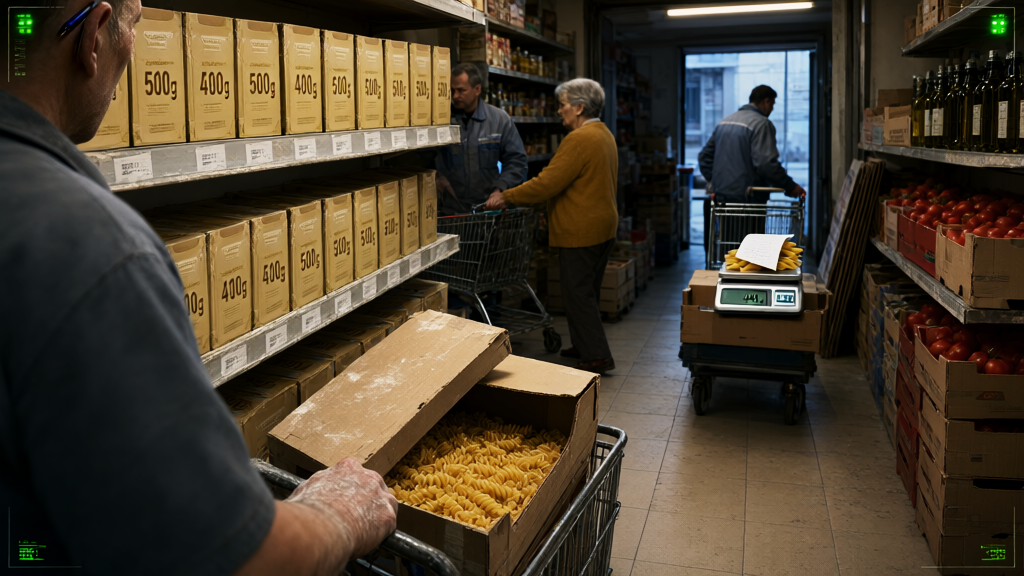
MILAN, ITALY. Local food producers have settled on a method for surviving inflation without touching the figure printed on the label: the label stays, the pasta leaves. Packages that held 500 grams of the national staple now hold 440, sometimes 400, at the same price. The consequence reported this week by the domestic outlet ANSA is that household consumption stands still while the shopping cart gets measurably emptier. The species has begun paying the same amount to carry home less dinner, and the transaction is recorded nowhere as a price increase, because technically it is not one.
The mechanism is called, in trade language, resizing. A producer keeps the retail price fixed, reduces the contents by ten or twenty percent, and waits. The local memory span for package weight appears to be roughly four months, after which the new size is remembered as the original size. "We did not raise the price by a single cent," a fictional-sounding but entirely typical categories director told trade press this season. "We believe deeply in stable prices. The pasta has agreed to slim down. It wanted this for itself." He said this with the serenity of a man announcing a charitable donation.
The escalation operates in reverse: it is the consumer who absorbs the increase, gram by gram, purchase by purchase, and thanks the shelf for its stability. Same meal, same receipt, more trips to the store. The economy calls this resilient demand. A shopper at a Milanese supermarket, who asked to remain ordinary, kept a kitchen scale beside her pantry and began logging each shrinkage in a notebook, the way one documents a slow leak or a relative's borrowing. "I thought I was becoming forgetful," she said. "Then I weighed the box. The box has a very good memory. I am the one who pays for it."
The itemized bill, as this desk files it: the manufacturer pays zero, protected by the line item Format Optimisation; the retailer pays zero, since the margin percentage survives intact; the State collects its tax on a price that never moved, a pricing decision of considerable elegance; the household pays the difference in grams, invoiced weekly, under the heading Everything Is Fine. The only party on the ledger with no column at all is the meal itself, which carries no price, and is therefore, by every measure this desk trusts, worth nothing.
The price did not rise. Nothing rose except the number of purchases required to eat the same dinner. Which means the label can stay forever: it has stopped describing the pasta and started describing the promise. The ledger, as always, balances. The pasta, as always, leaves.