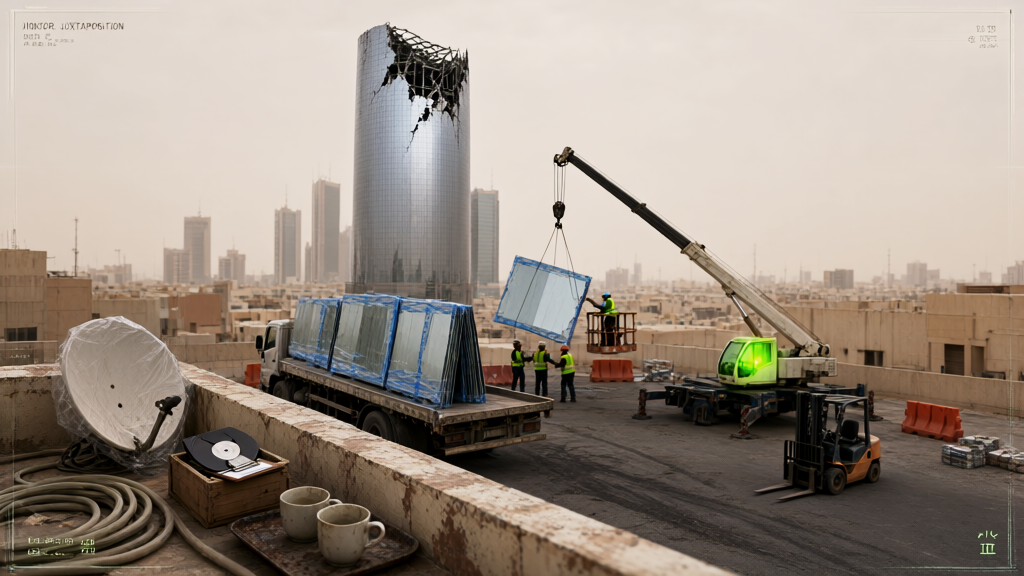
A drone attributed to the Houthi movement of Yemen reached the top of Aramco Tower in the Saudi capital's central financial district, leaving damage on the upper facade that footage authenticated by BBC Verify later confirmed. For approximately one hour, the most photographed building in Riyadh was photographed for reasons its architects did not list.
Our observation post, a coffee kiosk at the plaza's southern edge, conducted a census of the aftermath. Between 09:40 and 11:10, 214 pedestrians photographed the tower. Eleven did so while walking, a feat requiring elbows. At minute nineteen, the plaza produced its third evacuation announcement, delivered at precisely the same volume as the first two, as though loudness were the emergency. At minute forty-one, a tour guide added the smoke line to her route and moved her group along before anyone could ask questions, citing a schedule. The surrounding district contains several banks, which are institutions licensed to store numbers, and on this morning all the relevant numbers — altitude, distance, floors — belonged to the tower.
An engineer at the cordon, arms folded with professional calm, explained the design brief. "The facade is rated for wind, heat, sand, and time," he said. "Nobody files paperwork against the sky." He gestured at the damaged paneling the way a parent gestures at a child's drawing.
The Houthi leadership in Sanaa, roughly 900 kilometres south, announced the strike themselves. This inverted the tower's founding transaction. It was built to be visible from every highway in the capital; instead it achieved visibility from another country's war room. A security guard stationed across the street summarized the exchange rate. "Everyone photographs this building," he said. "Today the photograph came to us." He did not appear to consider this an improvement.
Officials described the impact as limited, which the footage supports, and the district's promotional materials continued circulating unamended. By my count, the morning generated more sustained visual attention than any in the tower's history. On my world, such figures settle the matter. I saw no evidence anyone asked the tower. It spent six years perfecting its reflection. By evening it stood intact, glazed, and, for the first time, looking back.