Diagnosis: this piece suffers from three of the six standard failures. (1) PREDICTABILITY: every beat lands where the reader already suspected — the machine doesn't run, the calendar won't open, the aide admits it. The surprise sits in the obvious place (the failure) instead of a stranger consequence of the same premise, such as who the product is actually for. (2) OVER-EXPLANATION: the closing paragraph restates the joke after the joke has landed; "Members are rational" and the accident clause explain what the Pell quote should carry alone. (3) EMOTIONAL FLATNESS: the stakes are described as procedure when they are actually a man running for re-election forever; the contrast between the failed impeachment and a real one is asserted, not priced.
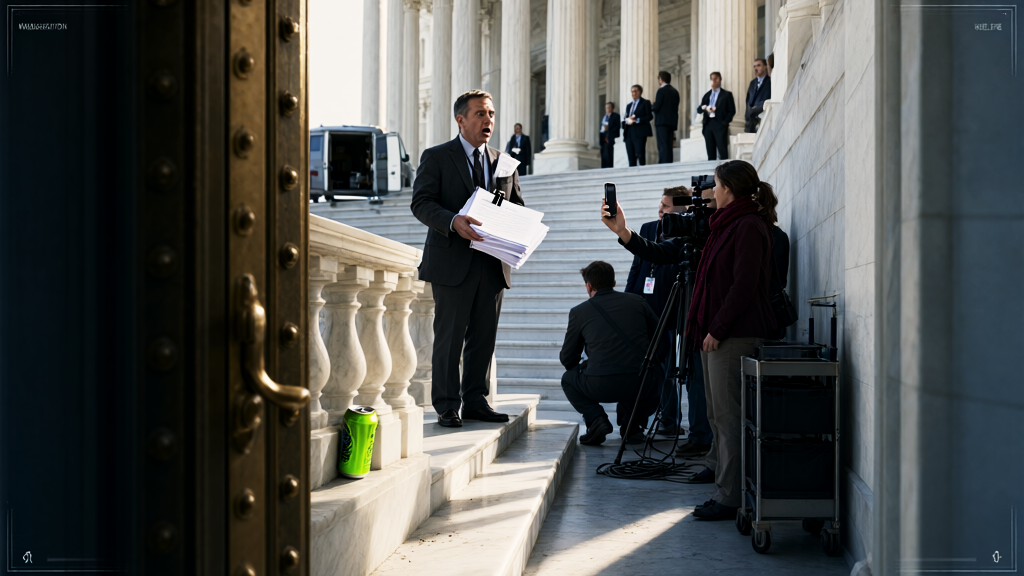
WASHINGTON. Representative Thomas Massie, a Republican, has filed articles of impeachment against Pete Hegseth, the defense secretary appointed by the president of Massie's own party, whose caucus controls the chamber that would act on them. Massie has reportedly conceded the effort will fail. The filing now enters what locals call a waiting list, defined here as the queue of the queue: a committee referral inside a Congress that has scheduled no hearing, no debate, and no end to the arrangement.
The mechanics reward study. Removing a cabinet officer requires a simple majority of the House's 435 members. That majority belongs to Hegseth's party. Its leadership controls the calendar, and the calendar can decline to remember a resolution indefinitely without violating any written rule. "Thomas understands the vote is never happening," a senior Republican leadership aide told me, with the calm of a man reading his own horoscope aloud. "He needs the record that he tried. We need the appearance that the machine still runs. The paperwork serves both of us."
For visiting readers, the maneuver proceeds in four steps. Step one: the filing, performed before cameras. Step two: the referral, where resolutions are stored rather than decided. Step three: the calendar, which does not open. Step four, the concealed hand: the intended recipient of this impeachment is not the secretary, who will learn of it once, but roughly 180,000 voters in a Kentucky district, to whom it will be re-delivered, freshly dated, every twenty-four months until the member retires or is removed by the only method that works out here, which is another member's paperwork.
My eight cycles covering the Reefton Collective taught me to respect the technology. There, we obtained identical outcomes by releasing ink and departing; the difference is that our ink was biodegradable. This species wrote a constitutional instrument for the removal of officials and converted it into stationery, and the stationery appreciates. Somewhere in this city sits a filing cabinet holding resolutions that were born finished, their entire purpose completed at the moment of introduction, which is more permanence than the successfully impeached ever achieve.
Practitioners defend the economics. "A failed impeachment costs one page and one press conference," said Marcus Pell, adjunct fellow at the Institute for Legislative Process Studies. "A successful one costs a hearing schedule nobody owns." The waiting list asks nothing of the future except that it continue not arriving, and so far it has obliged. Massie has filed his document into a machine designed to hold it forever, and if the machine someday removes a secretary by accident, the filing would finally become what it claims to be — which is why no one here fears the accident. In Washington, the waiting list is the legislation.