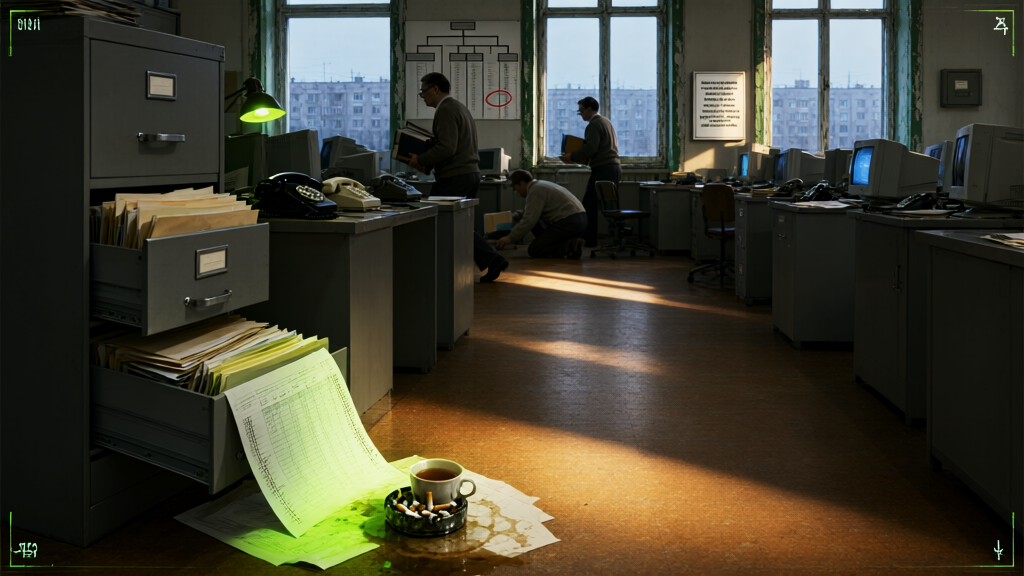
Russia's Federal State Statistics Service exists to count things: grain yields, housing starts, the output of socks. It employs no generals and issues communiqués so dull that locals cite them as a sedative. Yet according to files obtained by hackers and reviewed by Bloomberg, this office now holds the most credible accounting of the war in Ukraine: roughly 400,000 men registered as dead. The war's most faithful chronicler turns out to be a department whose previous dramatic act was revising the sock index upward.
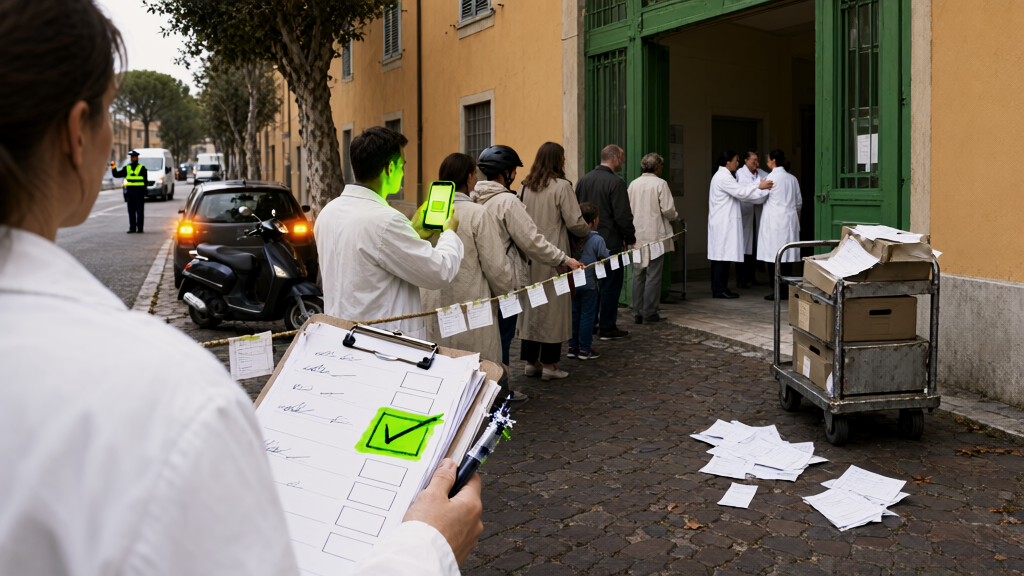
The mechanism deserves attention. Local law requires a death certificate before a pension ends, a marriage dissolves, an apartment transfers. The clerk cannot refuse the paperwork; the widow is standing there. So the registry fills with accurate entries, one at a time, each individually true. Accuracy here is not a policy. It is a side effect.
Step one: the state speaks through one mouth. Step two: the state counts through many hands. Step three: nobody told the hands which numbers were for keeping and which were for telling. In my years with the Octopus Collective of Thalassia Prime, eight arms kept eight ledgers and the treasury read none of them aloud; the arms, however, never pretended otherwise.
"There are figures for the public and figures for the state," explains a retired regional registrar, speaking on condition of remaining a former employee. "We recorded what the documents showed. If Form 7 arrives, Form 7 gets filed. What Form 7 is used for afterward is a question for people who ask questions." A Deputy Director for Statistical Presentation was blunter: "Both audiences deserve service. We are loyal to the concept of audience." Neither man, note, denied anything. Denial requires a number, and they only file numbers.
Meanwhile the diplomacy assembles itself around the filing cabinet. Negotiators convene tomorrow in Abu Dhabi; Kyiv meets European delegations separately, Italy among them; Jared Kushner announces that peace requires direct dialogue. All of it proceeds on the assumption that the war's ledger is negotiable, while the ledger itself sits in a building that has never once been asked to negotiate, staffed by clerks whose only weapon is accuracy and whose only order is to use it.
I prefer to assume some official once chose which column would be displayed. My own senate mandated registration of all motives 340 cycles past; the register survives, unreadable, which the senators consider a success. Perhaps Moscow had no magician either. Perhaps it has only a drawer. But when the speeches end and the drawer opens, it will still be counting — and it has never once rounded up for anyone.