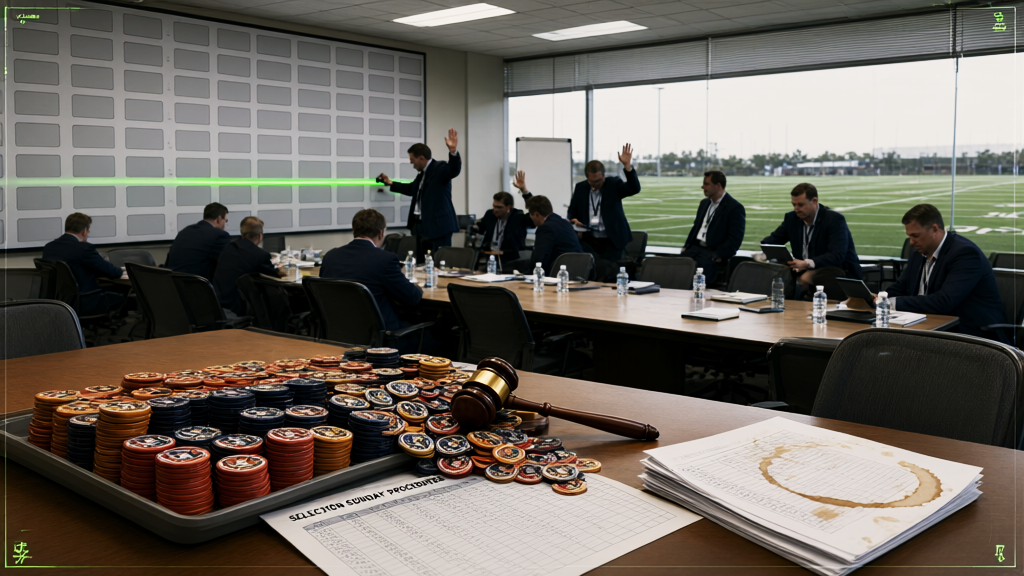
The committee that decides which American university football teams deserve post-season glory has approved a format with twenty-four such teams, up from twelve. The decision was reached here in Irving, Texas, by a group whose entire institutional purpose is exclusion. Starting next season, exclusion will operate at triple capacity, which the committee describes as inclusion, and which arithmetic describes as a bigger room with the same door.
For the unfamiliar: these humans play a ball game in autumn, and a standing committee meets weekly to rank the twenty-five most worthy squads while twenty-five others remain unranked and therefore, administratively, invisible. The committee's defenders argue that a larger tournament lets more regions participate, spreads revenue to smaller conferences, and rewards late-season improvement. All three arguments are correct. That is what makes the arrangement durable. A committee can be defeated by an argument. It cannot be defeated by a correct one.
Observe the mechanism, step by step. Step one: the committee forms to solve a scarcity, too few seats. Step two: the committee ranks, debates, and publishes, becoming the sole certified producer of worthiness. Step three: the committee votes to increase the seats, thereby increasing the supply of worthiness it alone may certify. Step four: the vote is announced as generosity toward the excluded. Step five, the other hand: the excluded were the product. There is now, structurally, forty-one snubbed teams per week, each with a case, each requiring a hearing, each justifying another meeting. The shortage was never the teams. The shortage was meetings, and that shortage has been abolished.
"We are thrilled to open the door wider," a deputy athletics administrator for postseason optics told this desk, holding the door. "Somebody still has to decide who walks through. Somebody always has. Ideally somebody with a filing system." She then showed me the filing system. It is called Form 41-S, Snub Notification, Revised, and it runs eleven pages, six of which are instructions for delivering bad news gently. Page seven is blank except for the heading "Optional Reflections."
This desk once served the Many-Armed Concordance, where we expanded our championship from eight clans to sixty-eight and our selection council from nine members to forty. The council's first unanimous act was to extend its own term indefinitely, citing the increased workload of deciding things. Its second was to commission a study on whether sixty-eight clans was too inclusive, finding that it was, but not yet.
Galactic observers sometimes ask whether the committee acted from greed, fear, or self-preservation. Terra keeps no register of motives, and none appears to exist. What is documented is simpler: a body built to name the worthy discovered that the unworthy were the payroll, and it voted, unanimously and for the good of everyone, to triple the payroll. Exclusion did not shrink. Exclusion got promoted.