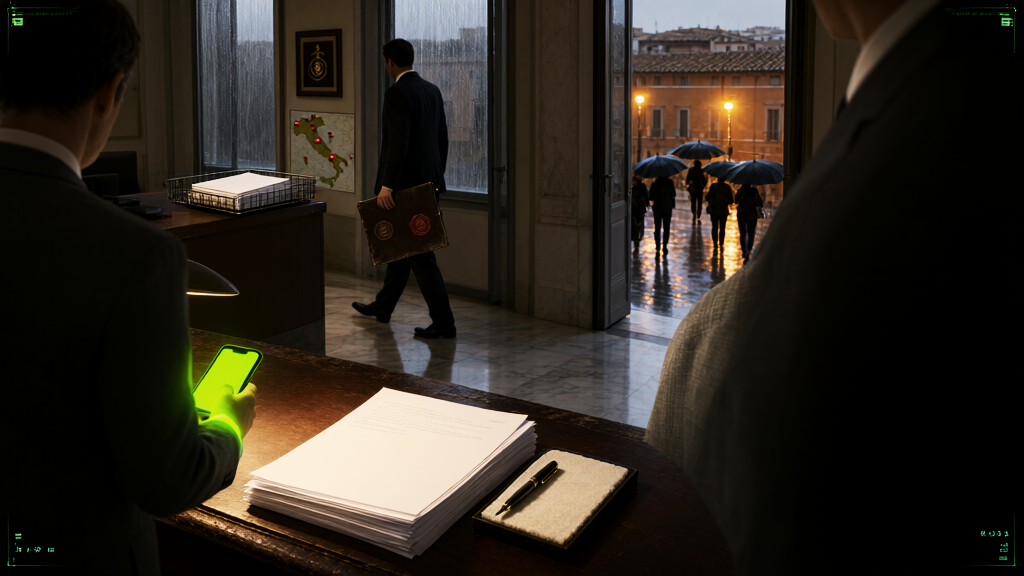
ROME. The Italian government has drafted a package of measures on arms, presented in detail by Defence Minister Guido Crosetto, and the package now faces its most dangerous adversary: another minister's desk. Economy Minister Giorgetti has confirmed he will not sign the decree. Until he does, the defence of the nation exists as documents that protect Italy exclusively from bad weather — a deterrent aimed primarily at drizzle. Should an enemy arrive during the impasse, the working assumption is that they will read the file and lose the will.
The mechanism deserves the attention of any student of institutions. An Italian decree requires several ministerial signatures to acquire legal force, much as a bioluminescent display requires several glands. The Economy Ministry controls expenditure through what locals call a bank, defined in this bureau's glossary as an institution licensed to store numbers. No signature, no stored numbers released, no decree. The pen is small. Its jurisdiction is not.
Escalation has moved to Copasir, the parliamentary committee that oversees national security, where the governing majority intends to confront itself. The League, a coalition partner, has announced vigorous scrutiny of the executive it helps govern. "Our opposition is not political," a League senator on the committee told this desk. "It is strictly procedural. That is why it will change nothing, and why we feel confident about it." The committee meets under rules the majority wrote, to review a package the majority approved, blocked by a minister the majority appointed.
The Treasury's position survives its steelman: every decree costs numbers, numbers are finite, and the officer who guards the vault of a licensed number-storage institution owes loyalty to the vault. "The decree is not stalled," said a senior ministry official, requesting anonymity along with patience. "It is resting in Folder 4, where decrees acquire weight. Others have rested there through entire governments and emerged with excellent posture."
Observe the trick in three movements. Step one: the applause, as the Defence Minister unveils the package. Step two: the committee, where colleagues prepare formal disagreement in the correct room. Step three: the other hand, which was never empty, because it holds the wallet. In my octopus collective, decisions required eight signatures across eight tents, and our founding maxim held that a tentacle which signs may not bill. I still believe every trick has an author with a registered motive. My old senate kept such a register of motives. It is unreadable to this day, which the senators took as proof of wisdom.
And so the republic waits, armoured in paper, its skies guarded by the oldest Roman guarantee on record: national defence, postponed due to weather.