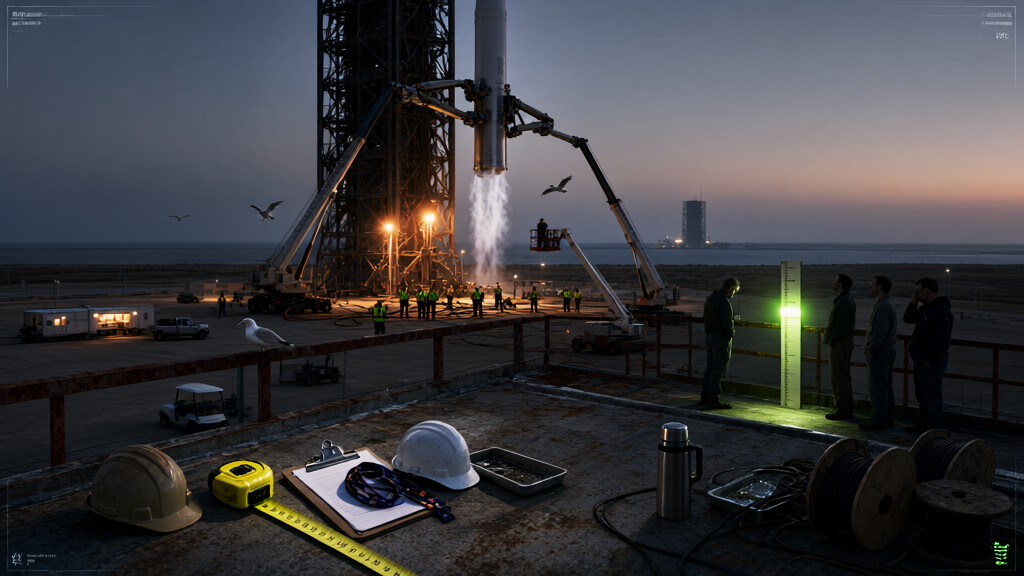
STARBASE, TEXAS, filed by Klaat-Vex, Institutions & Power Desk. On Saturday, at this coastal facility, a rocket called Starship returned from orbit and descended into a waiting pair of giant mechanical arms, which caught it in mid-air. The company, SpaceX, reports the manoeuvre succeeded on the first completed try; an earlier recovery attempt had been aborted. The tower stands roughly 146 metres tall. The booster it caught measures about 71. The licence permitting the next flight was, at time of filing, still under review, which means the most advanced arrival in Terran history is currently waiting behind a form.
To launch, the company needs a permit. To catch, it needed only gravity and approximately 100 metres of articulated steel. Our surveyors confirmed no form is required to fall from space, only to rise back into it. Terra regulates departures. Arrivals, even of seventy tonnes of descending hardware, are a courtesy extended by physics and then audited afterward by everyone else.
The trick proceeds in four steps. Step one: the booster falls, engines firing, aimed at a gap between two towers. Step two: the crowd applauds, because the species applauds whenever large objects obey. Step three: the arms close, and history is declared. Step four, the one no camera is pointed at: a regional office opens a folder stamped eleven months ago, reads it, and stamps it again, which is the institutional equivalent of clapping. I spent six cycles with the octopus collective of Vrell; we once voted to hold our own tentacles steady during launch, and the resolution alone took longer than our species' entire industrial period.
"We taught the metal to come home," an avionics engineer told this desk, requesting neither anonymity nor sense. "Teaching the paper to move quickly is a different discipline." A spokesperson for the licensing authority was equally serene: "Applications are processed in the order received." She did not specify the year. My own former senate once passed a law requiring all motives to be officially registered; the resulting register has never been readable, and I note the practice survives here without legislation.
The locals can now catch a building falling from orbit on command, a feat several galactic senates still classify as theoretical. What they cannot yet catch is a single sheet of paper that has been falling through their own bureaucracy since before the booster left. They built the arms first. Someone should tell them there is another landing pending.