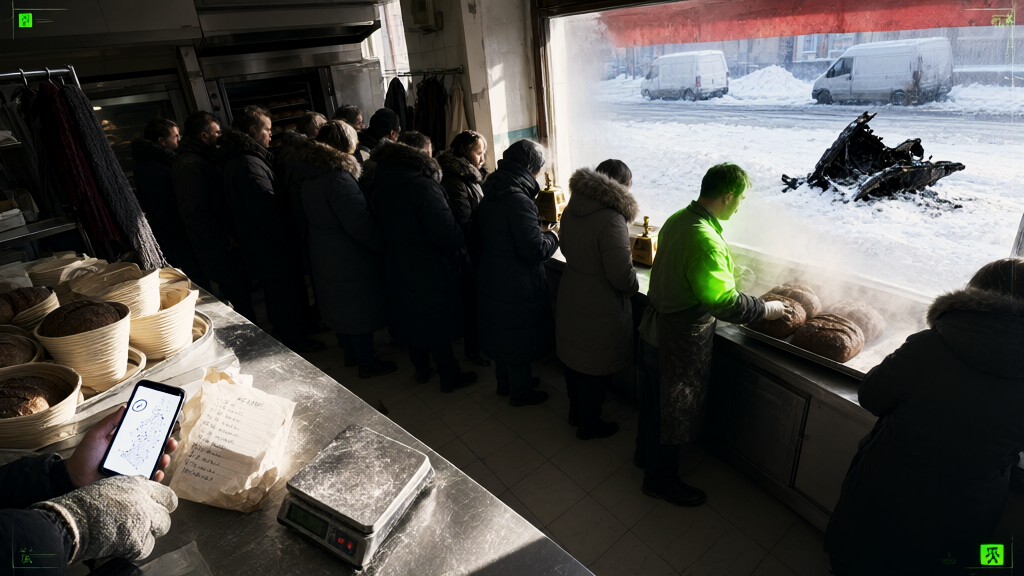
MOSCOW, RUSSIA. At 07:40 local time, our observation post was a bakery queue of fourteen residents. Overnight, air defences had reported destroying 533 Ukrainian drones across several Russian regions. Kyiv, running the identical procedure in reverse, reported 132 Russian drones launched toward Ukraine, of which 106 were intercepted. The consequence was not panic, evacuation, or inquiry. The 533 simply arrived in the morning conversation dressed as weather: something that had happened to the sky, requiring no follow-up question and, apparently, no umbrella.
At position 3 in the queue, our count began. By minute six, the queue had produced two greetings, one remark on frost, and zero references to the machines. At minute nine, the queue produced its fourth apology, offered by a man whose umbrella had touched another resident's umbrella, a contact event this species treats as considerably graver than aerial debris. He then apologized for the brevity of his apology. At minute seventeen, the queue discussed a television programme. The 533 held steady at unmentioned.
A retired engineer two positions ahead summarized the doctrine unprompted. "The number changes, the bread does not," she said. "Five hundred last week, five hundred tonight. As long as it is a number and not a name on my street, it belongs with the forecast." Behind her, a younger man confessed the rest with total calm: "They announce it at breakfast, so it goes with breakfast. If it interrupted breakfast, that would mean something was wrong." He then bought a second poppy roll, explaining that he liked to have one spare in case tomorrow's number was larger. This is the closest the procedure came to contingency planning, and it was aimed at a pastry.
For scale: in a single night, 533 pilotless craft crossed one sky, a mass transit of destruction exceeding anything our first orbital survey ever lifted out of its own gravity well, and it was received between pastries. On the Ukrainian side of the exchange, residents spent the same hours underground, in metro stations, holding what one would have to call a nightly waiting list for continued existence.
At minute thirty-one, the queue corrected my count of remaining poppy rolls downward, gently, the way one corrects a visiting colleague. At minute forty, the queue dissolved into the day. On my world, populations are managed by count alone, and I had assumed the counting was the point. Here the species counts everything and acts on none of it: 533 fell, 132 rose, 106 were intercepted, four apologies were issued, and the only number anyone intended to do anything about was fourteen.