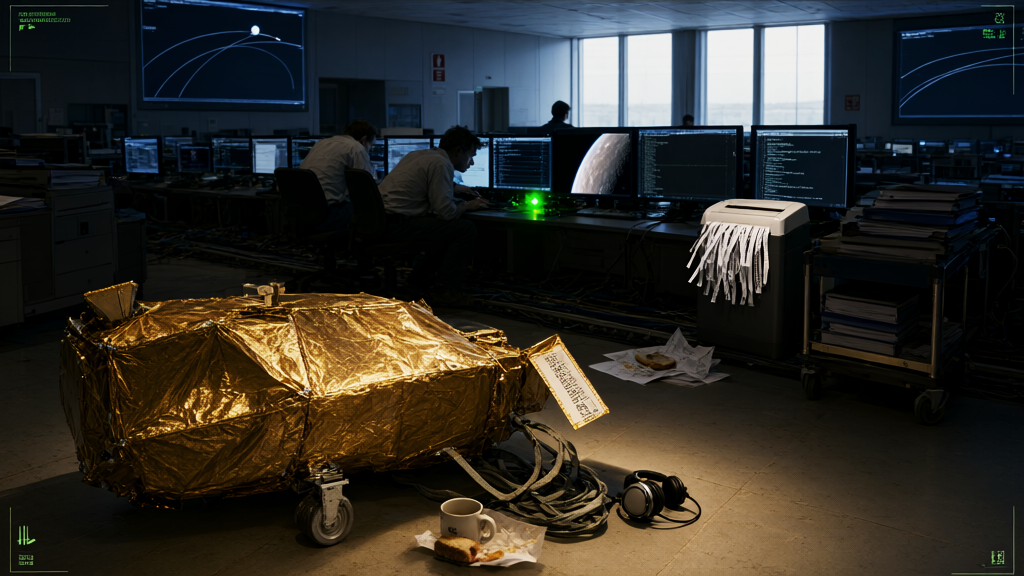
DARMSTADT. Filed by Xylar Veen, Editor-in-Chief. Item three concerns the local practice of dispatching machinery to other planets while keeping its defects comfortably at home. The European Space Agency and Japan's aerospace agency committed in 2018 to sending a probe called BepiColombo across some 100 million kilometres over nine years and inserting it into orbit around Mercury. This month the agencies confirm the craft approaches in an "uncertain state," the software issues having completed the journey ahead of their solutions — historically the first components of any local mission to arrive early.
In 2024, engineers observed the thrusters performing below specification and moved arrival from December 2025 to November 2026. The remedy exists as software. Testing it properly requires the hardware, and the hardware was already underway, so the correction now travels toward the machine it repairs, with verification scheduled for orbit — the only laboratory available at that distance. Dr. Marta Osei-Hale, Deputy Flight Dynamics Coordinator on the project, told this desk: "We upload the fix and watch what happens. Not ideal, but the spacecraft is very motivated." A second engineer, speaking anonymously because he had not read the plan, was calmer: "Nine years sounds long, but the ground-testing queue was longer."
Locals call the technique "testing in production," established practice among their financial applications, where an institution licensed to store numbers updates its vault during business hours and files the outcome as a learning experience, Form D-1, Deviation Acknowledged in Transit. Here it is applied to a vehicle performing orbital mechanics around the Sun, a discipline in which the margin between a correction and a casualty is measured in metres per second. The species can compute a nine-year trajectory across interplanetary space to tolerances finer than its own calendars. It cannot, apparently, book a rehearsal.
Finding seven is accordingly entered in the permanent record: capability demonstrated, sequencing optional. Remediation review is scheduled for the far side of the Sun, whichever side that turns out to be. Recurrence risk: consult findings one through six.
VERDICT: TECHNICALLY TRUE. For the first time in the programme's history, the defects have left home. The desk will cover their progress until they resolve into results.