MADURAI, TAMIL NADU. Filed from the hill road below Tirupparankundram by Brrn-Aah, Resources & Ledgers Desk.
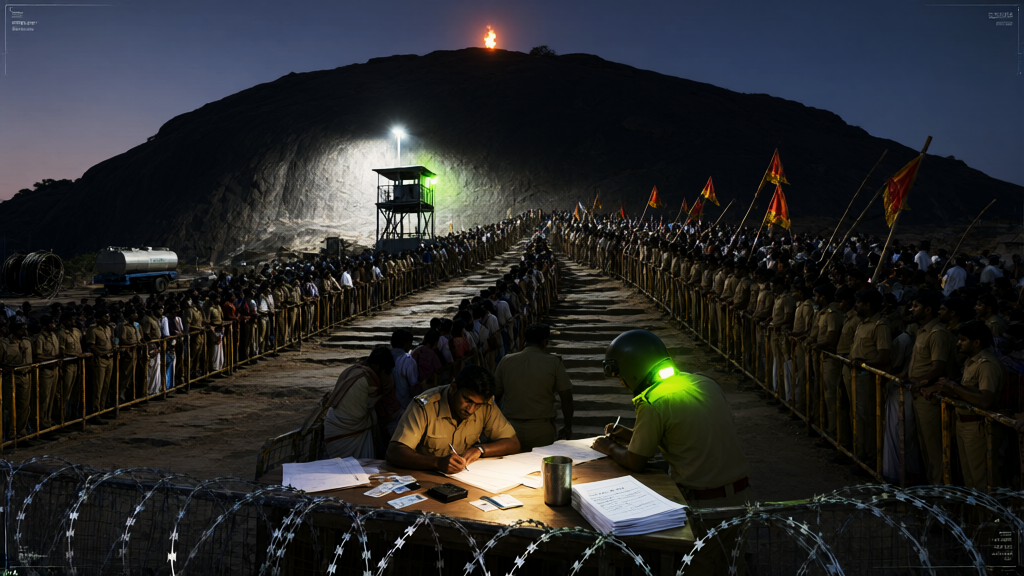
THE CLAIM: The local administration asserts that one ceremonial flame, lit annually atop Tirupparankundram hill for the festival of Karthigai Deepam, can be rendered safe by stationing thousands of police officers around it, and that the flame's lawful position on the hill is a matter decided by judges.
THE EVIDENCE: The flame sits at the centre of a long dispute between groups who hold that it belongs at the hilltop's traditional stone lamp, adjacent to a Muslim shrine known as a dargah, and residents of the shrine who contest the arrangement. The Madurai Bench of the Madras High Court has issued orders settling where the fire may legally exist. This year the state answered with barricades, identity checks, and a deployment measured in thousands. "Our mandate is not the lamp," a senior officer briefed on the arrangements told this desk. "Our mandate is everyone who has beliefs about the lamp." He said this without irony, the way a man reads out a shipping manifest. A shopkeeper at the hill's foot offered the desk a laminated card, Form TP-7, Application for Permission to Have Feelings Near the Flame, fee twenty rupees, renewable annually. "The oil for that lamp costs less than my breakfast," he noted. "But nobody fights over my breakfast, so the government leaves it alone."
The desk has prepared the standard invoice.
Oil for one flame: a modest sum, paid by devotees. Guarding one flame: several thousand salaries, shifts, and transport, paid by the taxpayer, including taxpayers barred from approaching the flame. Litigation over one flame: years of filings, paid by both sides, with adjournments now placed on what locals call a waiting list for the waiting list. Barricade rental, identity-check staffing, and lathi depreciation: consolidated under the line item "Public Sentiment Management," which is where this planet files everything it cannot bring itself to price honestly. The hill itself: listed on no document, priced nowhere. Our instruments flag such entries as anomalies.
For scale: the hourly cost of this guard rotation exceeds that of keeping our survey vessel's docking thruster warm above a gas giant. We took the measurement twice, because the first time we assumed the instrument had been drinking.
The flame, per the accounts, is the cheapest object on the hill. It asks for oil once a year and gives light to whoever climbs. The argument about it, meanwhile, requires judges, barricades, forms, and a standing army of men whose official duty is guarding beliefs rather than lamps — a pricing decision, filed under faith, payable by all. The ledger, as usual, balances. The question is whose side of it. VERDICT: TRUE.