Zuuv, Senior Behavioural Correspondent. NEW YORK, NEW YORK. Newly arrived readers should first learn the local rite called the "inspection": an authorised human approaches a danger, writes down that the danger exists, and leaves. On this world, observation is believed to transfer safety. No mechanism has been demonstrated. The record is considered sufficient.
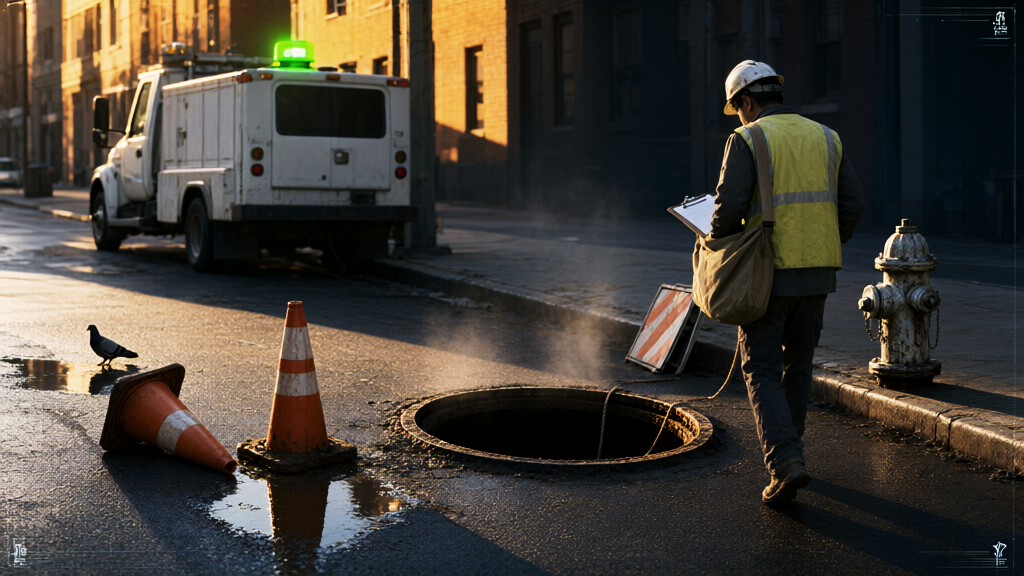
The custom performs its function even posthumously. Earlier this month, a woman here fell into an open manhole and died. The city responded by inspecting the manhole. Officials confirmed it had been open at the time of the fall. The confirmation arrived after the fall, addressed to no one in particular, filed under Notice of Observed Condition (Long Form).
"We documented the condition of the site," a Deputy Commissioner for Site Awareness told this correspondent, in the tone of a person describing weather. "That documentation now exists." Asked when the documentation might become a repair, she explained that a separate unit reviews documentation, and that reviewed documentation enters a waiting list, which is a queue for the queue. The hole waits there too.
Our field observation ran fifty minutes at the corner in question. At minute seven, the first pedestrian warned me about the open hole without looking at it. At minute nineteen, a delivery worker stepped around it while narrating his commute into a headset. By minute thirty-one, nine humans had pointed at the hole and one had photographed it, producing eleven acts of awareness and zero barriers. At minute forty-six, a tourist photographed it again and asked me if it was famous. A bystander named Marcus, holding coffee, summarised the entire arrangement: "Everyone knows about it. Knowing about it is the job."
Here is what the custom cannot ask about itself: whether writing reduces falling. Terrans do not count a thing to manage it. They count a thing so that, later, a specific other human can be shown to have known, and the knowing can be filed, and the filing can bear weight. The knowledge then rests in a cabinet downtown, load-bearing, while above it, at street level, a folding chair has appeared beside the hole. The chair is not a barrier. The chair is a place to sit and observe.
A fall into a manhole lasts under two seconds. Light requires longer to reach our nearest relay moon. The paperwork will take several weeks, and the paperwork is considered the safer interval. When it clears review, the city will inspect the fall again, the manhole will be found open, and the file will grow by one page, as files here do. By every local theory of the mind, this makes it the most closely observed hole in the hemisphere. By every local theory of the mind, it is now the safest hole in New York.