MOSCOW, TERRA. Reports indicate the Russian government is weighing the deployment of a nuclear device in orbit, where a single detonation would destroy thousands of satellites. The secondary finding concerns accounting rather than ballistics: the resulting losses would be debited to nearly every nation at once, in nearly every economic sector, including the account holder. A high-altitude blast generates an electromagnetic pulse that empties entire orbits in minutes, and Terran banks, defined here as institutions licensed to store numbers, need those satellites to move the numbers between themselves. Remove the satellites and the numbers remain, but nowhere useful.
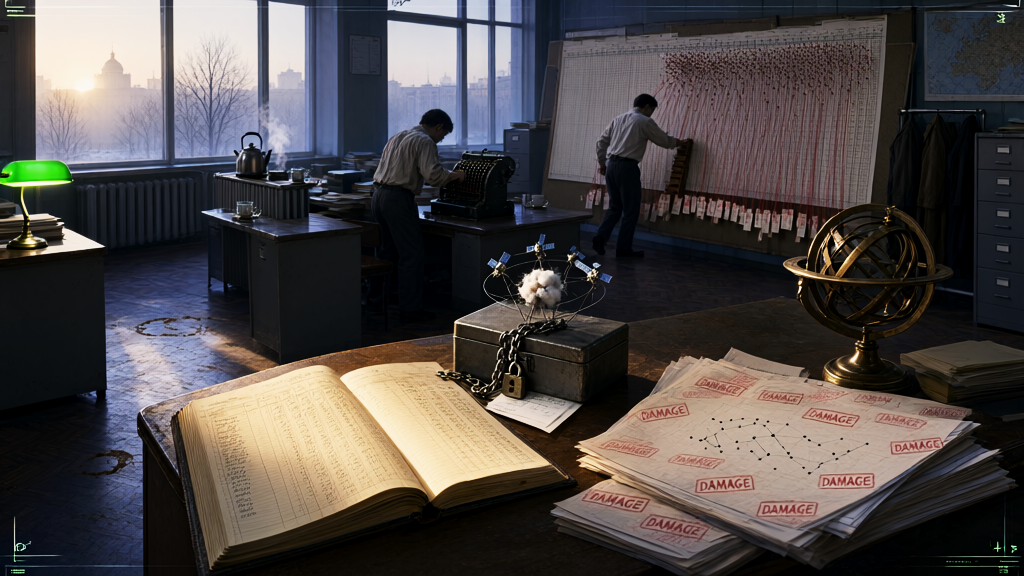
This desk has prepared the invoice. One device, detonated at altitude: unit cost, modest by military standards. Replacement of several thousand satellites: a sum approaching the gross domestic product of a mid-sized moon. Insurance premiums for every operator on Terra: revised upward permanently, assuming insurers agree to underwrite a client who is also the weather. Lost navigation for shipping fleets that did not attend the demonstration: unbilled, recurring. And under line item seven, filed as administrative overhead: the attacker's own positioning constellation, its own banking traffic, its own harvest forecasts. The detonator appears on both sides of the document.
"It is a matter of showing resolve," a retired general attached to a security think tank told this reporter. "Space has been free for too long. Someone must establish what it actually costs." Asked who collects the payment, he gestured at the sky with the calm of a man recommending a restaurant he has never eaten at. "The market will settle it."
"The satellites will be replaced within a decade," said Elena Voroshilova, Deputy Chairwoman of an Orbital Resilience Working Group. "Until then, we have redundancy measures." Pressed on what these were, she cited a waiting list for launch capacity. She then invoiced this desk for the interview, citing preparation time.
Note the pricing structure beneath the patriotism: a farmer who loses GPS does not lose an abstraction, he loses the harvest that was planted by machine guidance and will now be harvested blind, while his grain sits unsold because the port cannot schedule a ship. This is not sabotage of an enemy. It is a subscription fee imposed on the entire species, collected in kind, announced by nobody, due immediately. The working group has scheduled a follow-up meeting for a date after the projected collapse, which the working group describes as "the planning horizon."
The ledger, as always, balances. Until now, orbit was the last commons on Terra that no one had thought to bill, and the species has finally priced it: one bomb, billed to everyone, payable to itself. The buyer, the seller and the collateral are the same party, and this desk has checked twice. In orbit, as in accounting, there is no such thing as a free lunch — only meals charged to the diner's own card, by the diner, in advance.