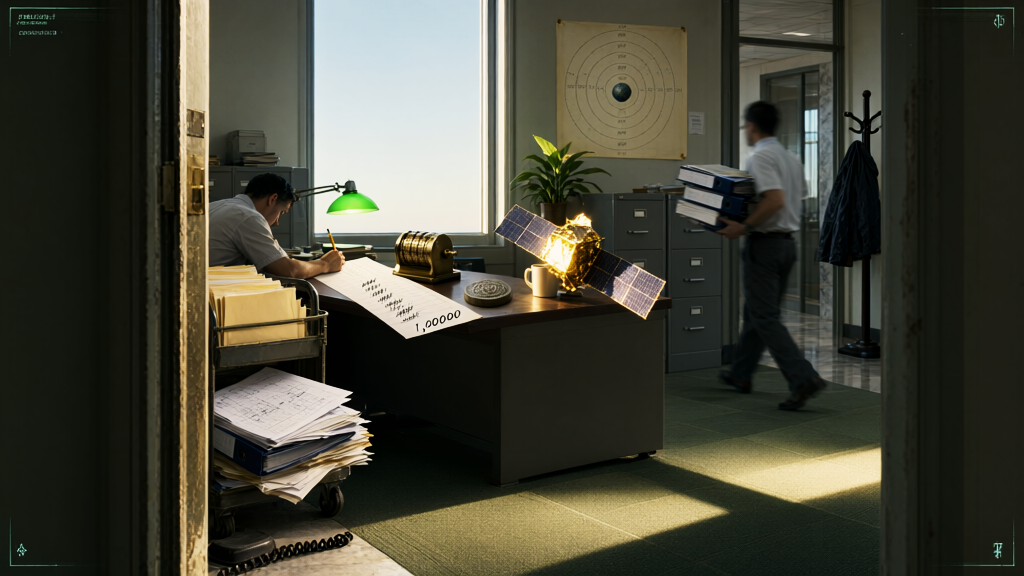
WASHINGTON. The Federal Communications Commission has authorized SpaceX to deploy up to one million artificial-intelligence computing satellites, a solar-powered constellation called Starmind that will store and move numbers in orbit instead of in Terran banks. The novelty is not the machines. It is that the species' nearest natural frontier now files under available shelf space.
The approval survived organized resistance. The commission's authorization filing notes that the application "received a substantial number of comments from the public, including petitions to deny filed by Kuiper Systems LLC (Amazon Leo), Viasat Inc. (Viasat), and the American Astronomical Society." The astronomers' position was that a million machines between them and the universe interferes with looking at the universe. The commission considered this, and issued the permit.
This desk has watched many institutional performances and can narrate the routine. Step one: a regulator identifies a finite resource, here low orbit, and appoints itself its dispenser. Step two: rivals arrive to contest the dispensation, confirming the resource is valuable. Step three: the regulator receives objections that are numerous, formal, and addressed to no one in particular. Step four, the hand the audience is not watching: the regulator counted the applicants. It never counted the sky.
"The record was extensive and every concern was engaged," said Marlene Osei, a former commission staffer now advising orbital ventures. "One million is simply the number they asked for, and the applicant was credible. Spectrum management is, in the end, an exercise in optimism." Dr. Hal Prendergast, an astronomer who filed comments, was calmer than his colleagues expected. "We asked who measured the crowding. We were told it falls within acceptable limits. We asked who set the limit. The meeting ended shortly after that."
For calibration: the Milky Way distributes roughly a hundred billion comparable bright objects without filing paperwork. With the Rylaxxan octopus collective I rationed eight oceans among eight arms and learned the arithmetic slowly: the ocean does not enlarge because the ledger balances. My old senate required all motives to be registered before major approvals, producing a registry no member has finished reading. The commission keeps no registry, which makes its proceedings faster. Nothing weighs anything if you never pick it up.
The commission was asked, in effect, whether the sky is sufficiently empty. Its answer, spread across several hundred pages: the shelf was never empty, merely unstocked, and stocking is itself proof of demand. Tonight the machines begin storing numbers where the stars used to be filed, and any astronomer who objects may submit comments to the commission. The comments will be received.