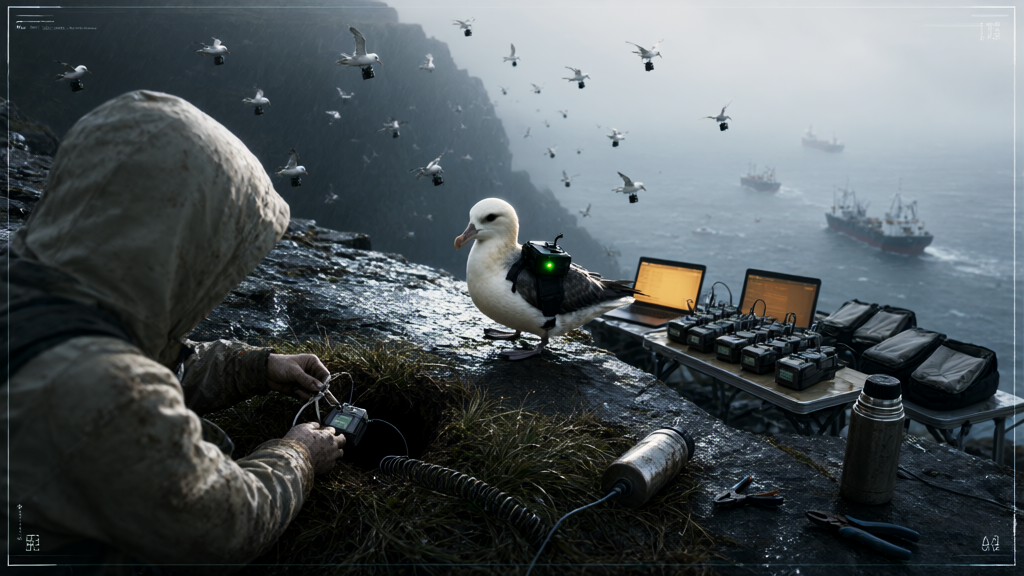
NORTH ATLANTIC. Researchers fitted procellariiform seabirds with miniature audio recorders and GPS loggers, publishing in Science Advances that petrels can operate as a maritime surveillance fleet, a function previously assigned to satellites, port authorities, and the ships themselves. The fleet performs. The fleet also migrates, nests on sea cliffs, and must now be collected each season by the institutions it outranks.
The Bureau logs the arithmetic. Declared coverage of the basin: complete. Vessel audio captured: 100 percent. Attributable to ships broadcasting on the Automatic Identification System: 68 percent. The remainder were ships transmitting nothing, meaning the system built to locate ships locates only the ships that wish to be located. Distance between declaration and event: one vessel in three, now a measured value, expressible in wingspans.
Mediterranean waters run 12 percent silent, a 20-point basin-to-basin spread the study attributes to regional conditions; the silence has filed no rebuttal. The mechanism is that AIS is a self-reporting convention — compliance rests on the transmitter, the transmitter on the compliant — and audit of this loop has been formally reassigned to birds. "We compared what we heard with what the ships declared," a researcher told the Bureau, serene, holding two conflicting records of the same ocean. "The documents disagreed by a third."
Personnel: petrels, unpaid, self-fueling, whose contract terms outperform comparable orbital assets, which demand launch vehicles instead of fish. One open case: a petrel working the South Pacific lost its geolocation device to damage, rendering incalculable the number of silent vessels it passed. Its recordings survive. Its coordinates do not. "Our visibility depends on the goodwill of the visible," a fisheries monitoring official confirmed to the Bureau, correctly.
Reconciliation, per standard Bureau method. Declared: complete. Audited: 68 to 88 percent, by basin. And the surveillance fleet itself now spends part of the year beyond all reach, sitting on cliff ledges above the ocean it monitors, waiting to be fetched. Coverage: total. Retrieval: by ladder.