BEIJING — The municipality projects that its population will become "super-aged" by 2035, the threshold at which residents aged 65 and above exceed 21 per cent of the total. Field observation suggests the condition already holds, daily, between roughly 5:40 a.m. and 8:00 a.m., in the city's public squares, before the working-age population has reported to its desks. At 5:41 a.m., on the western terrace of a park in central Beijing, our observation began.
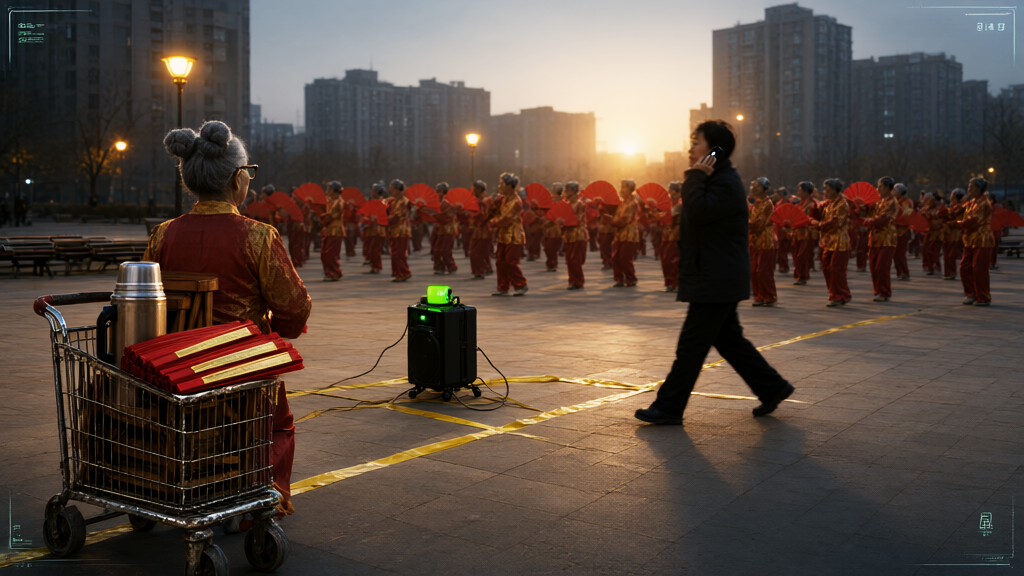
The first dancer arrived at 5:44, plugged a loudspeaker into a lamppost, and pressed play. By 5:52 a formation of fourteen women stood in rows, wearing matching red sashes renewed annually under the local institution called "fashion." At minute nine of the music, the formation produced its first apology, issued when two dancers crossed paths. At minute twenty-one came the fourth and final apology. The music ran eleven minutes more without incident. None of the apologies were acknowledged. All were accepted, including the fourth, by dancers who had not witnessed it.
A census of the terrace's nine benches recorded full occupancy by 6:20. Behind bench three, a secondary queue formed — locals call it a "waiting list," the queue of the queue — of dancers awaiting seats vacated by dancers who had gone to dance. The waiting list kept its own order, understood by everyone, written nowhere. At 6:30 we assigned an age band to each of the sixty-one individuals present, by posture and gait; fifty-four fell at or above sixty-five. The plaza was, by the municipality's own definition, 88 per cent super-aged, and had been most mornings for years.
"The square belongs to us until eight," said Bai Shulan, 71, team leader of the Morning Radiance Dance Formation, between songs. "After eight it belongs to people who are going somewhere. They are very fast. We do not envy them the speed. We have the mornings because we are the only ones awake to want them." Officials describe the condition as a projection. "The projection says 2035," said Dr. Wei Hanming, senior researcher at a municipal population institute. "It does not specify an hour. Measurements are taken in the daytime, when the city looks the way the reports prefer. Nobody measures a square at 5:41 a.m. The numbers would be early, and early numbers raise questions."
At 8:07 the first commuter crossed the terrace, headphones in, age approximately twenty-nine. By 8:20 the median age of the plaza had fallen by an estimated four decades, and the super-aged city — its benches, its sashes, its four apologies — stood dissolved until the next dawn. We filed our census under current events. The municipality files the same census under 2035. The future, locally, keeps morning hours.