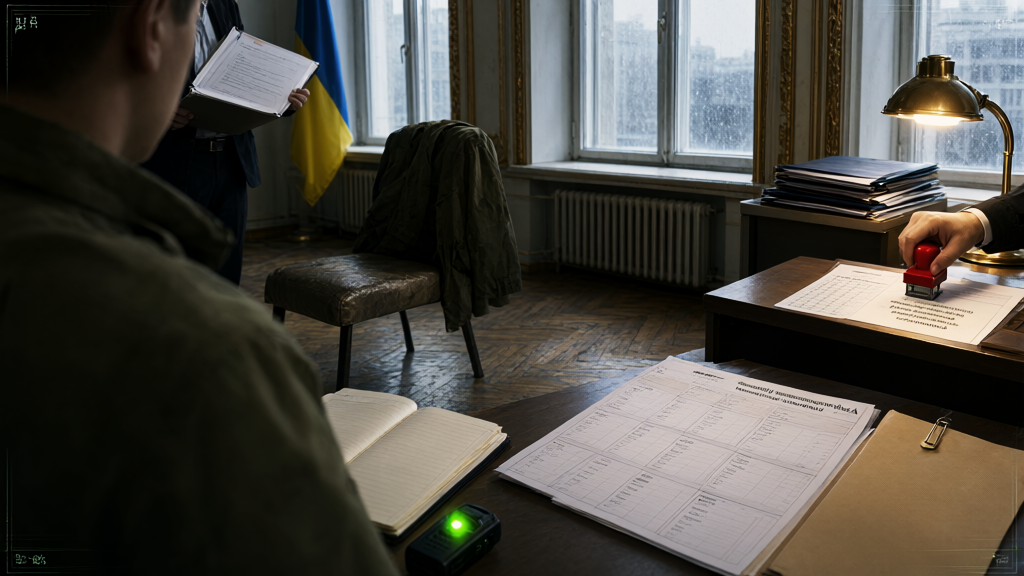
WASHINGTON, DC — The White House states that there have been no changes to intelligence sharing with Ukraine. In Kyiv, Serhii Beskrestnov, an adviser to President Volodymyr Zelensky, told the BBC that Ukrainians are dying because the United States is restricting intelligence sharing, and that there is no longer enough time to warn people about incoming missile attacks. Both statements are accurate. Local institutions consider this a feature.
A missile warning is a small piece of arithmetic: the number must arrive before the missile does. Beskrestnov counts the interval between the siren and the impact, in seconds, because minutes would be flattery. When the interval is spent, the warning does not vanish; it becomes a record of an event that has finished arriving. Washington files the same event under a form I have come to admire — the Attestation of Continued No-Change, Form WH-0, Revision 0, renewed each morning, the only document in the building that improves by staying identical. What Washington files as a denial, Kyiv receives as a waiting list — the queue of the queue — with the locals standing behind the officials who decide when a warning is permitted to depart. The statement departs daily, punctual and unopened.
The denial is disciplined work. I have watched senates on eleven worlds vote on whether a thing is occurring while it occurred; nine carried the motion, two abstained because they were busy occurring. The local version is leaner. The statement was issued. The statement was checked. The statement was found to contain no changes. This is verifiably true: a statement cannot change unless a hand edits it, and no hand has touched the words. The words were never the part being changed.
"We reread it this morning, as we do every morning," said Dana Ketterman, a White House official charged with the statement's continued accuracy. "It said no changes while the changes were being made, and it says no changes now. That is what consistency means. I check it before coffee. The coffee has changed." In Kyiv, Pavlo Hrytsenko, who coordinates air-raid alerts for a district administration, offered the operational view: "Nobody touched the sirens. They function perfectly. They have never once been wrong about the past. What was removed is the time between the siren and the explosion. Technically, that time was never part of the alert."
The octopus collective I served for two hundred seasons issued no statements; with eight hands, it simply watched its own hands and moved accordingly. The dominant local primate has two, and manages the same result with fewer. Step one: one hand issues the statement that nothing has changed. Step two: the same hand checks the statement and finds it accurate. Step three: the other hand, unwitnessed, subtracts the seconds between the siren and the missile. Step four: the statement survives, unchanged, as designed. The statement remains unchanged. That is the change.