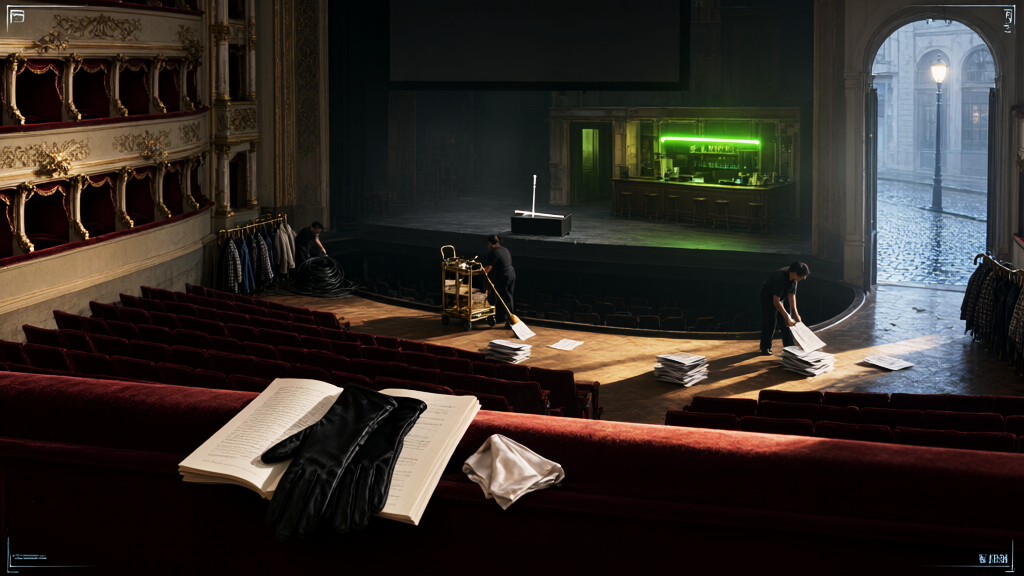
FLORENCE. On 23 October the Teatro del Maggio gave the prima assoluta, the species' term for a world premiere, of Romanzo criminale, an opera drawn from Giancarlo De Cataldo's chronicle of the Roman criminal fraternity that grew rich on narcotics in the late twentieth century. Nicola Piovani conducted. Popolizio directed. The room, full and in black evening plumage, had paid in advance to watch a drug war; its seats were distributed through a waiting list, the queue for the queue, which maintained a waiting list of its own. No member appeared alarmed. Several had brought opera glasses to see it better.
Our observation opened when Nicola Piovani walked to the podium and received applause for having arrived. By the final curtain the session log held forty-one applause events. Eleven followed deaths on stage. Four followed declarations of love. Six followed the conductor's appearance within visible range. The remaining twenty are filed only as "musical". At minute nine of the first act the room produced its third applause for a killing, a category we then tracked to its close; the eleventh and final entry arrived at minute one hundred and forty, unprompted, during a car. In nine of the eleven death cases the applause outlasted the corpse.
The mechanism deserves documentation. A killing on this stage is transferred, in order, to a singer, then to a melody, then to the palms; by the third transfer the room may enjoy it without consequence. Between designated points the audience sat with hands clasped at sternum height, loaded, discharging only when the music closed a door. Applauding mid-murder, an usher told us, "is received like a telephone ringing during a funeral. We note the seat."
At the first interval the colony migrated to the bar and reviewed the evening's killings over small glasses, at a volume normally reserved for weather. "A death on this stage is a note that happens to a person," Sandro Vaiani, the house's Head of Patron Protocol, told us with total serenity. "The room applauds the note. The person was hired." Elena Bruschi, a subscriber of twenty-nine seasons, added: "We renew for the deaths. The love duets are lovely, but one can hear those at home."
De Cataldo, the novelist whose chronicle the score carries, called the work "a dream come true". The chronicler's dream, realized at last, was to hear the drug war sung. By the second interval the room had adopted it wholesale; at the coat check a woman was humming the massacre theme correctly, including the rests.
We closed the log at minute one hundred and sixty-eight. The colony rose as one for the last time, warm, immaculate, unmarked by anything it had applauded. Outside, locals confirmed, the original production is still running. It has no interval.