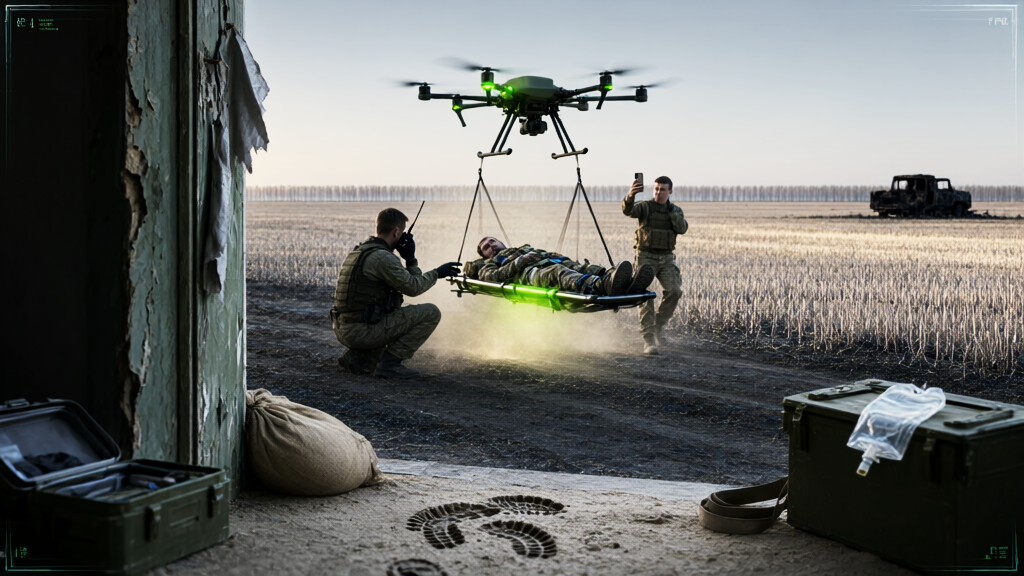
KHARKIV OBLAST, UKRAINE. On Monday, in footage reported by NBC News, the 92nd Separate Assault Brigade announced what it calls the world's first evacuation of a wounded soldier by aerial drone. A heavy-lift hexacopter collected the man, flew him low over blurred-out territory, and lowered him carefully at the far end, where the operator greeted him: "Welcome back to the ground!" Standard procedure for inbound freight; the amendment for freight that answers is still pending. One detail stands out to this desk: the freight secured itself. The soldier rigged the harness and cinched the straps himself — the first shipment in brigade history to perform its own pre-flight inspection.
The aircraft was not the medics' choice. Enemy drones and landmines had made conventional ground evacuation too dangerous, which in local accounting means too expensive: every ambulance kilometer now draws fire, and fire is billed in fuel, crews, and blood, net thirty. The brigade did not redesign rescue. It repriced it.
"Nobody in this brigade preferred a drone to a stretcher," said Maj. Oleksandra Kovalenko, the brigade's deputy chief of medical evacuation. "The enemy set the toll, we audited the road until it priced itself out, and the invoice picked the aircraft. People assume medicine made this call. Medicine was consulted. The budget decided."
"A wounded man is the only cargo that signs for its own delivery," said Capt. Andriy Marchenko, the brigade's acting quartermaster. "He straps himself in, we route him like batteries, and he thanks the aircraft at both ends. Find me another pallet that does that." The heavy-lift airframes were bought to move freight, and the ledger draws no line between pallets that bleed and pallets that do not. An airframe that has dropped its shells bills the return leg as a rescue; no item in the inventory is cheaper to move and harder to replace.
The desk files the transaction as follows. The road: one unit, closed, its closure priced in mines by an enemy who paid nothing and invoiced everything. The aircraft: one heavy-lift hexacopter, six rotors, one harness, last vendor standing. The operators: paid in blurred faces, booked under security. The soldier: fare prepaid at enlistment, grateful, self-loading. The whole exchange books under "casualty movement, non-standard, inbound" — the same heading this desk uses for generators. The ledger, as usual, balances. The question is which side of it you ship on.