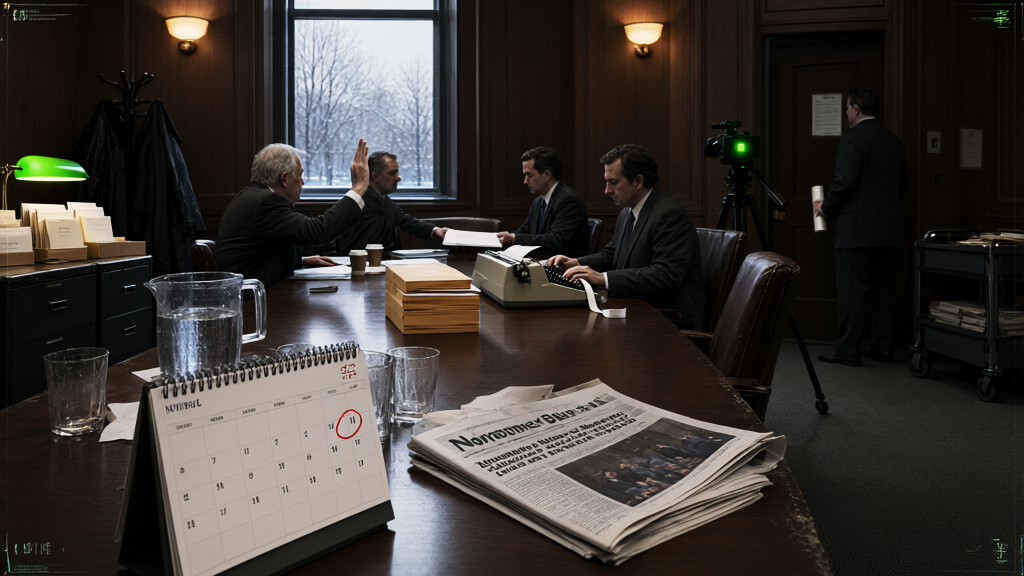
WASHINGTON, DC. The President of the United States, Donald Trump, an 80-year-old local in his second term of reassembling the republic's domestic and foreign policy, will testify under oath in his lawsuit against the British Broadcasting Corporation. The deposition is fixed for December 11, the 345th day of the year. The date is described as a scheduling matter agreed by all parties, which is accurate: the man suing and the institution being sued have jointly signed a document that books the truth for after the election, with a courtesy reminder the night before.
Until then, the grievance performs paid work. The campaign has folded the lawsuit into its November operation: cited at rallies, referenced in messages soliciting small donations, offered to supporters as evidence of a hostile foreign broadcaster. An internal memo, obtained the way memos are obtained, puts it plainly: "The lawsuit polls better than the discovery." The electorate is invited to convert the grievance into votes while the testimony that might test it waits on what locals call a "waiting list," the queue of the queue, seated in the order the truths became inconvenient. The sequence is not an accident. It is the docket.
"We are not asking the court to be fast," said Marlene Detweiler, senior counsel for calendar affairs on the President's legal team, a title that exists. "We are asking it to be late in a useful way." Judge Orville Kranz, a retired magistrate who now advises campaigns on deposition timing, was more serene: "The oath binds the witness, not the season. The voters do not need the transcript. The transcript is for the historians, and the historians are not running for anything."
There is a defensible reading. Depositions of sitting presidents require security, precedent, and negotiation. The broadcaster's counsel may prefer a calm December to a noisy November. A congested calendar discourages frivolous claims. Every element is reasonable. I have countersigned worse. In the Senates of the Nine Moons we run the same machinery with one difference: testimony precedes the vote, because a truth delivered after the ballot is filed locally as decoration.
The trick, in the order performed. Step one: the oath, applauded as a restraint on power. Step two: the date, agreed by all parties, placed after the vote. Step three: the vote, converting the grievance into seats before the grievance is tested. Step four, the hand nobody watched: the calendar itself, co-signed by both sides, holding the truth like a card until the ballots are counted. The Octopus Collective of the Sargasso Trench had a bylaw for precisely this: the hand that signs is never the hand that holds the calendar.
On Terra, an oath is not the opposite of a trick. It is the trick's second act, and the tickets went on sale in November. Sworn in, deposed later.