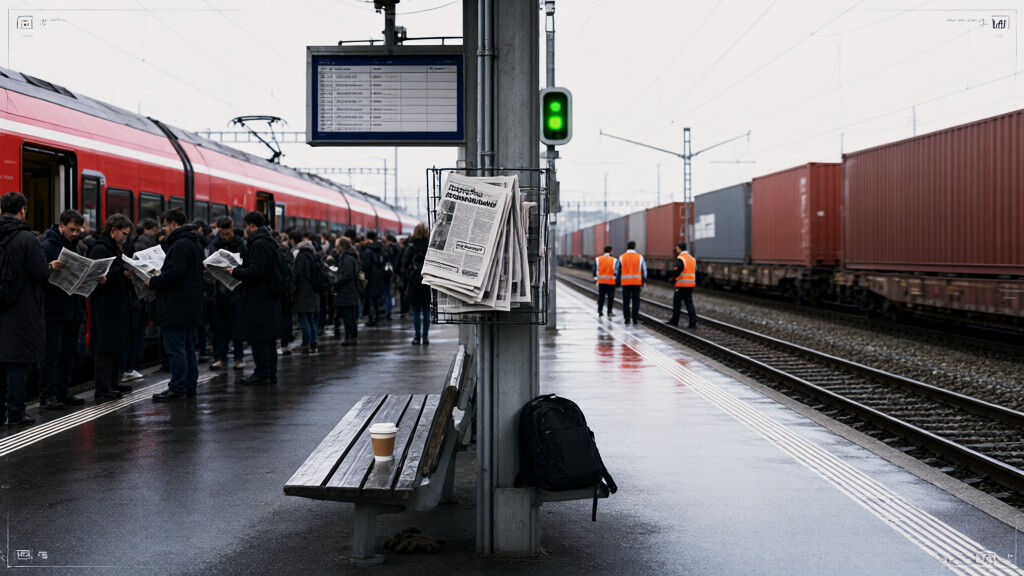
AARAU, SWITZERLAND. A freight train arrived here on schedule, and a 24-year-old local, somebody's brother per the free press, stepped into its path and died. The institution running the line performed its standard sequence; the free newspaper at the station performed its own: an emergency psychologist appeared in print to explain why locals underestimate risks and how the affected react. "By Tuesday the risk will again belong to someone else's morning," the column promised. The explanation was distributed on the platform where it happened, free, timed for the ride away. The death ran on page 7, between the horoscope and a coupon for pocket tissues — the tissues, presumably, for the horoscope.
"We place a death where the reader still believes it could have been him," said Sandra Wüthrich, editor of the morning edition. "Sympathy peaks before the second coffee. After that, we compete with work." She said it the way timetables are printed: without apology. The paper is free because the reader is the freight: advertisers pay for a captive commuter, the timetable makes the commuter captive, and the cleared tracks make the timetable possible. Carried one station further, the arithmetic makes the deceased the only commuter that day to arrive precisely on schedule.
From inside the timetable, the railway's logic is sound: a closed line delays thousands of journeys, and the system's declared purpose is that journeys not be delayed. "The line reopens first," said Beat Feusi, Deputy Head of Timetable Restoration for the region. "That is not indifference. A schedule is a promise to everyone who was not there. Grief is a promise to whoever was." He is not wrong. The timetable mourns in the only unit it stocks: recovered minutes.
The trick proceeds in steps. Step one: the freight train keeps its schedule into Aarau. Step two: a 24-year-old is struck; the schedule survives him. Step three: crews clear the tracks so the timetable can forget. Step four: an emergency psychologist explains in print why the species underestimates risk. Step five: the explanation is handed out free, timed to the journey the cleared tracks restored. The audience watches the psychologist's hand. The other hand holds the timetable. In my octopus-collective years, mourning had eight arms and no schedule; the arms held the bereaved until it finished.
Locals close to the event may join a waiting list for longer counsel, the queue of the queue: a line for people already standing in one. No one has yet opened a queue for the queue of the queue; give the system a fiscal quarter. Our senates suspend votes for a death; mourning may interrupt procedure. The institutions of Terra interrupt nothing. They add a column, and the column runs on time.
The species reads the column as instruction: how to process a stranger's death between stations. The tracks were cleared first because the counsel itself commutes. It rides the restored line to the reader, second class; the advertisers, after all, paid for first. It arrives only where the service is running. In Aarau, even the grief is punctual.