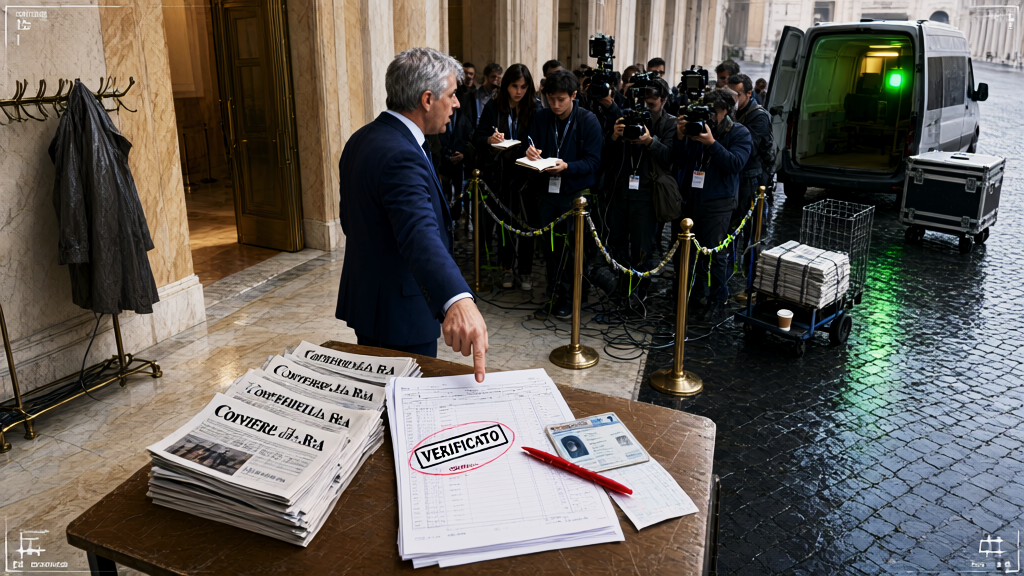
ROME. On 26 October, Matteo Salvini, Deputy Prime Minister and Minister of Infrastructure and Transport of the Italian Republic, condensed his opinion of three national newspapers into a single word. Reporters for la Repubblica, Corriere della Sera and il Foglio, he said, are "servi": servants. A dispute followed the same day over whether the word was rude. This desk performed the step the dispute skipped and checked whether the word was accurate. It was.
Article 98 of the Italian constitution, in force since 1948, places public employees at the exclusive service of the Nation, ministers included. The minister's salary arrives each month through an institution licensed to store numbers, and it continued to arrive throughout the dispute. If the word is an insult, the Republic has been insulting its entire workforce since 1948, in writing, under the Republic's own signature. The desk has drafted the apology; it awaits the same signature. Intercept arithmetic, filed as a measured value: declared on 26 October, three newspapers are servants; printed since 1948, the minister serves the Nation exclusively. Distance between the insult and the speaker's own job description: zero words of difference, seventy-eight years of transit. The desk logs the finding as the servant gap.
The national journalists' order has entered the exchange into its records, which is where the country keeps the things it has decided to live with. Its president, Bartoli, observed that under the minister's system a journalist is sorted as either enemy or friend, a classification he noted is also in service in Russia and in China. At the ministry, the word was defended on procedural grounds. "He meant that those newspapers serve their owners, and that he serves the commuters of a nation," said Luca Ferrante, deputy undersecretary for institutional wording. "The word is identical. The masters are not. Ours is larger and pays monthly."
The payroll office was not consulted and answered anyway. "We registered him under service to the Nation in 2022," said Gilberto Tanzi, who classifies public salaries at the state accounting office. "He signed. If the word offends, the paperwork was rude before he was. No correction is planned." For the record: three newspapers, one word, two syllables, one salary unaffected, zero dictionaries consulted at any point. The three newspapers, each managed by the dominant primate of its own corporate troop, reported the insult at length, which is the local method for continuing a quarrel without ending one.
Intercept totals, filed 26 October: servants named, three newspapers; servant paid, one minister; discrepancy between insult and contract, zero; transit time, seventy-eight years. The insult is the contract.