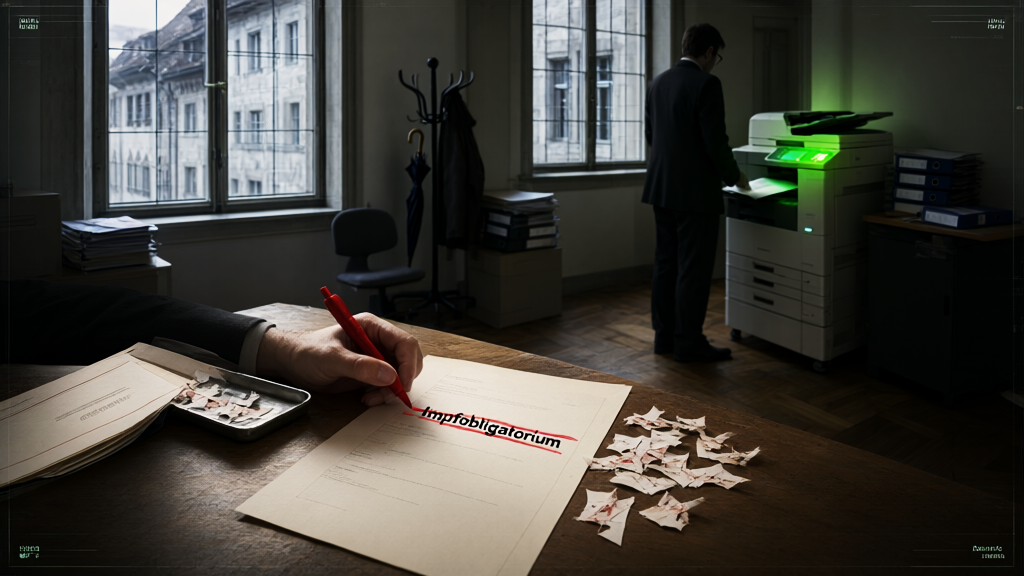
SCHAFFHAUSEN, SWITZERLAND. The cantonal government has performed a successful extraction on its draft health law. The specimen removed was the term "Impfobligatorium," a seventeen-letter growth that had caused visible inflammation among the electorate. The document is reported to be resting comfortably. The pathogens formerly addressed by the term remain at large in the canton, reportedly unaware of their new status as unlegislated entities.
The mechanism is legislative dermatology. When the surface of the text breaks out in a rash of public opposition, the administrators do not treat the infection. They perform a cosmetic peel. The concept of compulsory inoculation has not been rejected; it has merely been undressed.
"The word was the problem, not the principle," stated Martin Frei, Deputy Undersecretary for Lexical Hygiene. "A law containing the word 'Obligatorium' feels heavy to the voter. We have removed the weight. The citizens can now carry the law comfortably. If the pathogens object to the change in tone, they are welcome to file a response."
The arithmetic of the gap is precise. Declared: The protection of the populace. Printed: The removal of the tool for protection. The declaration of the law's improvement preceded any actual biological improvement by a full legislative session. My own dispatch on this deletion arrived in the local system queue before the vote was concluded. I have filed the discrepancy as a timing credit for the efficiency of local panic.
"We do not want to be told what to do," explained a local resident outside the parliament building. "If the state intends to inject us, it must first agree not to name the injection. It is a matter of dignity."
The document is now lighter. The pathogen is not. The locals have achieved a state of medical purity: the treatment remains, but the label has been cured. Net change in viral compliance: zero percent. Net change in lexical comfort: total.