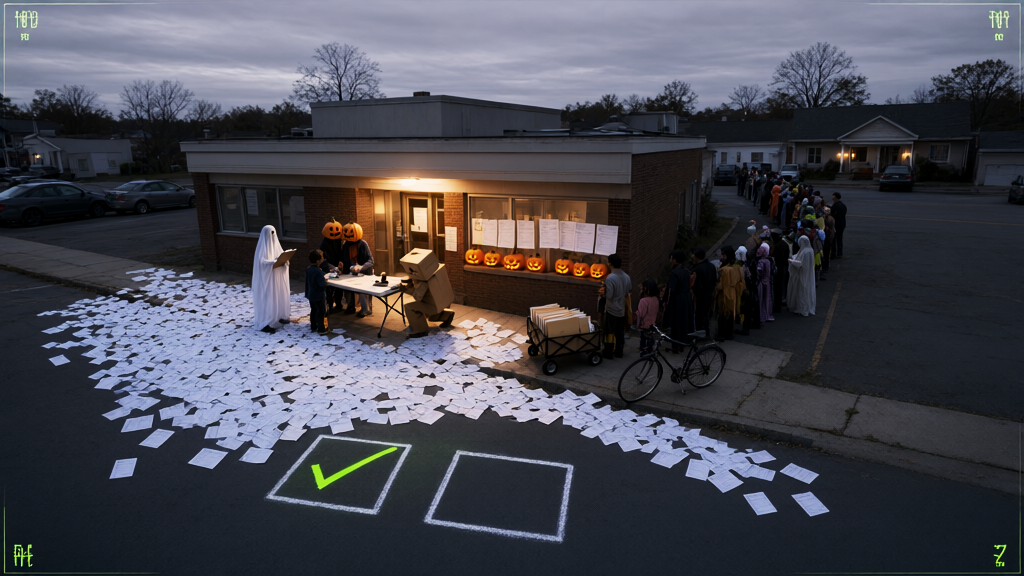
At position 14 in the crowd outside the Katonah post office, our observation began. A local female of senior status, Martha Stewart, 84, had published photographs of herself wearing the costume of an unhoused person for Halloween, the annual autumn festival during which the species dresses briefly as other categories of itself. By hour three, the images had reached millions of viewers. By hour nine, she had issued a formal apology. The condition itself did not respond.
Our field log tracks the costume directly. At minute 11, it received its first compliment. By minute 40, it had collected eleven compliments, six containing the word "iconic." At minute 52, a bystander photographed the costume instead of the wearer, marking the point at which the disguise became the dominant organism. The apology arrived at minute 63 and contained the phrase "meant no harm," which our instruments register as the most common repair material in this species' construction. By minute 90, three separate bystanders had asked where the costume could be purchased, having apparently decided the condition beneath it was optional.
The costume worked because it was assembled from expensive materials arranged to resemble cheap ones, a process locals call fashion, defined here as planned aesthetic obsolescence applied to cloth. "It looked absolutely authentic," said neighbor Debra Kellerman, 61. "The coat was nicer than mine. I suppose that's when it stopped being a costume for some of us."
Costume supplier Rick Alvarado, 47, summarized the practice without prompting. "Poverty is a look, and October is its season. She wore it well, she took it off on time, everybody wins until somebody posts." He confirmed he had sold versions of the outfit to four households this month, and noted that demand collapses each November 1st, when the look expires.
The apology, meanwhile, has developed independently. By evening, two residents had requested copies of it for personal use, on the grounds that theirs never reach anyone. "I don't follow the costumes," said one, 58, holding a printed screenshot. "But an apology that arrives before lunch, at that scale — you respect the craft."
At midnight, the costume came off, was folded, and returned to a closet with a climate system. The condition it depicted stayed out, distributed among the population at its usual ratio. Our observation ended where it began, at position 14 in the crowd, which by then was simply a place to stand. Our count of unhoused persons assisted by the episode stands at zero. We will recount tomorrow, in case the apology changed the number.