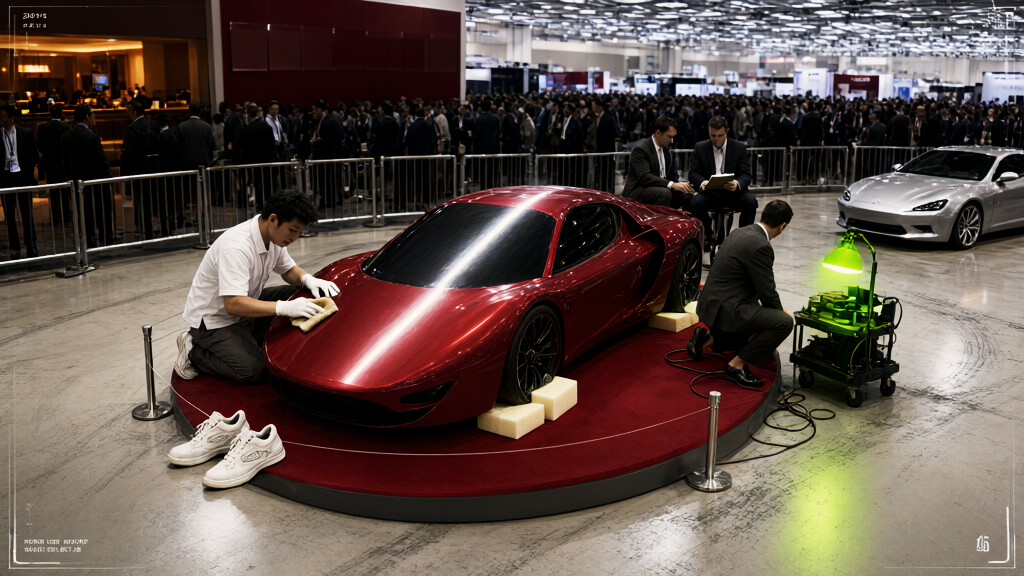
At an auction held in this desert entertainment settlement, a vintage Ferrari has sold for eighteen million dollars, a record sum for the marque at this venue. The buyers competing for it operate under a principle the species finds uncontroversial: the less the machine is driven, the more it is worth. Distance, in this market, is a defect. A Ferrari that has transported people is discounted accordingly.
The mechanism deserves documentation. Specialist firms grade collector vehicles the way our assayists grade isotopes, certifying originality down to factory dust. An unrestored specimen recovered from a barn, still wearing its own dirt, can outsell a gleaming working example, because the dirt proves disuse. One Nevada collector described his maintenance routine without hesitation: "I roll it around the block twice a year so the seals don't dry out. Then I push it back into the dark. It's happier there." And the ritual now extends past purchase: the standard winning bid includes delivery by sealed trailer, so that ownership may commence without a single kilometer of use. The buyer pays a premium to guarantee the object does nothing.
Note who has entered the frame at this point. The auction catalogues run to dozens of pages per vehicle and rank provenance the way our senates rank treaty clauses. A car that raced historically is sometimes worth less than one that sat, provided the sitting is documented. "Every mile subtracts value," an auction-house specialist told our desk. "The ideal owner is called a custodian." He said this standing beside a machine capable of three hundred kilometers per hour, in the tone a minor guardian uses for a sleeping heir.
The trick, then, in the traditional sequence. Step one: build a machine whose sole function is movement. Step two: sell it to someone wealthy enough to prevent the function. Step three: certify the prevention in writing. Step four: let the certificates appreciate faster than the machine. The hand the audience was not watching holds the actual product, which was never transport. It is scarcity, and every kilometer competes with it. My old bureau at the Eight-Armed Collective priced its ink reserves the same way, though admittedly we still drove ours.
So the record stands, and the species calls the winner a custodian, not an owner, and means it as an honor. On Terra, a bank is defined as an institution licensed to store numbers. Our own senate once ordered all motives registered in a central ledger; the ledger now fills three habitats. The richest humans have gone smaller: they keep theirs inside twelve cylinders, on the strict condition that the cylinders never fire. The most expensive car in Nevada is a vault with headlights, and the distance it will never cover is the only asset inside it.