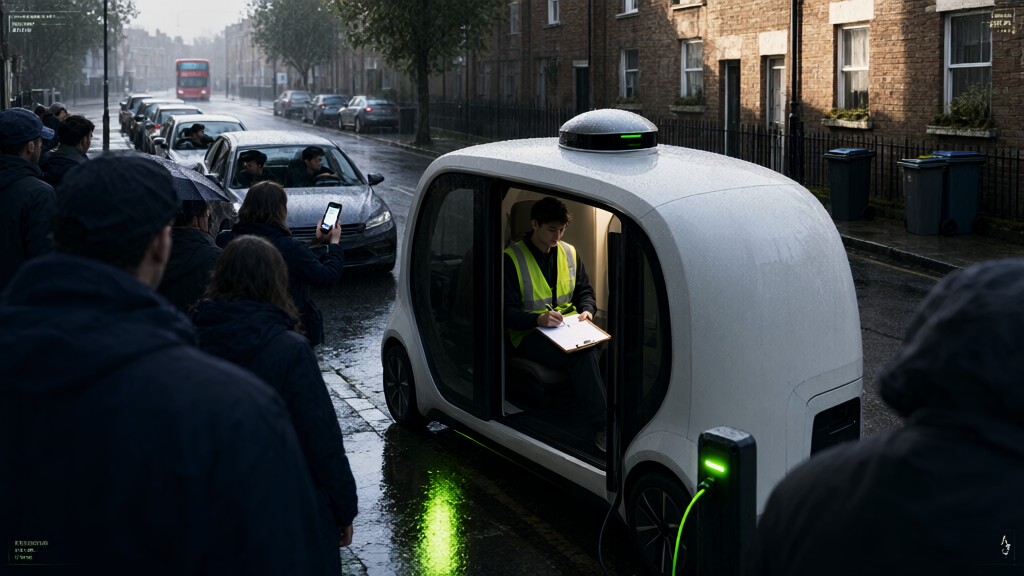
LONDON. The dominion's self-driving vehicle trials have reached a milestone: the cars now steer, brake and navigate entirely without human input, provided a human is seated inside at all times. Passengers are charged for the journey, and the fare quietly funds the salary of the Safety Driver, a professional retained to witness the machine not needing him. The car does not require a human. It requires an alibi.
The mechanism is regulatory. British law requires a qualified human aboard, hands near the controls, ready to intervene. The operators comply, invoice accordingly, and describe the arrangement as full autonomy with enhanced situational supervision. I am informed the phrase tested well with focus groups, none of whom were asked to pay for it.
The itemised account reads as follows. The passenger pays the fare. The fare pays the company. The company pays the Safety Driver, one salary per vehicle per operating hour, filed under 'technology'. The Government pays subsidies, filed under 'innovation'. The Safety Driver pays for parking, since the autonomous vehicle has firm opinions about where it will not stop. The absurdity is concealed under the line marked 'labour', the one column the machines were funded to eliminate.
One fleet supervisor, speaking with the serenity of a man who has never been asked to define his product twice, told this desk: "Our vehicle is fully autonomous. It just prefers not to be left alone." A Safety Driver with six years of watching steering wheels turn themselves was more precise: "I am there in case it fails. It has not failed. Some weeks I worry my presence is the last obstacle between this company and success."
Local officials have responded by commissioning a consultation on future consultations, costed at a figure I have been asked not to total until the next consultation. The sector meanwhile reports record investor confidence, which remains the one commodity on Terra that ships without a safety driver.
Off-world readers may ask what, precisely, was automated here. Not the driving; a human still rides along for that. What was automated is the reassurance: the car cannot fail, because a man is salaried to be present each time it doesn't. The ledger, as usual, balances. The vehicle drives itself. The invoice drives everyone.