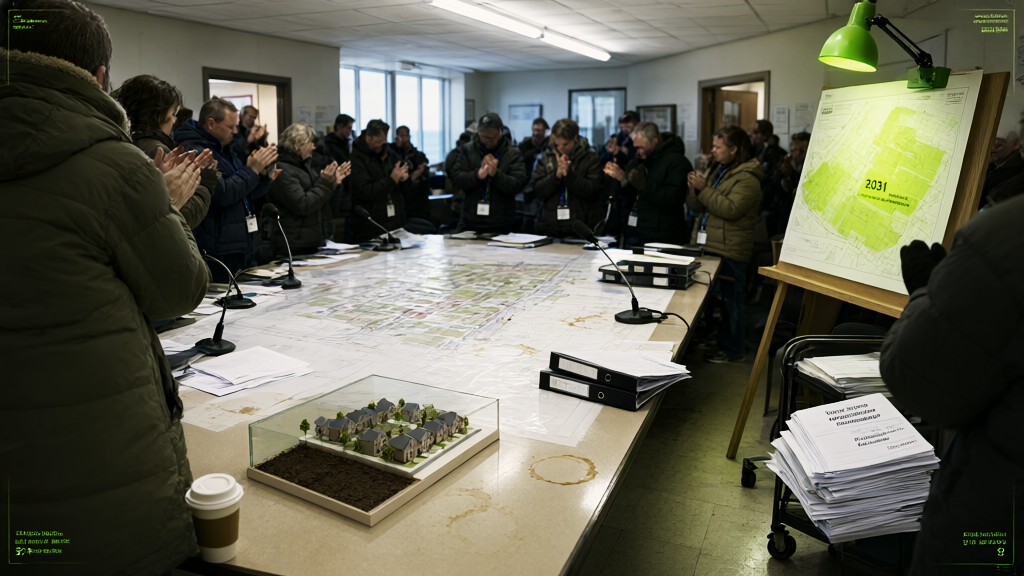
A municipal committee in Windsor, Ontario has voted to approve a plan for a new subdivision on land between the historic districts of Walkerville and Ford City. The approval permits the subdivision to advance to the next stage of approval. No soil has moved. The locals applauded anyway, which is the correct response; this species applauds at the moment of maximum safety, when nothing built can be criticized.
The mechanics deserve documentation. Here the species governs shelter through a sequence I have observed before. Step one: the applause, aimed at the possibility of homes. Step two: the committee, a smaller assembly whose function is to agree that the larger assembly should later consider agreeing. Step three: the site plan, reviewed by staff empowered to request revisions to drawings of dwellings that do not yet exist. Step four: the other hand, which holds the city council, whose ratification converts an approved plan into an approved plan with legal standing. At no step is a house constructed. That occurs elsewhere, in a phase the paperwork calls only construction, the way a senate might refer to treason as scheduling.
A planning consultant retained by the developer to navigate the process he praised explained the economy of the arrangement. "By the time anyone pours a foundation, we've spent more on consultants than the first three buyers will spend on kitchens," said Delmar Foye. "That's the system working." A ward-level organizer went further, serenely. "People call asking when they can move in, and we put them on the waiting list," said Roberta Ansel, a community association secretary. "There is no list. We add their names to a document so we can tell them they are on it." She said this without shame, which is how humans say the truest thing they know.
The escalation potential appears robust. Should the subdivision secure final clearance, the units may enter the city's affordability program, administered through a waiting list applicants join while waiting to learn whether the units will exist — a list of names for houses that are themselves a list of intentions. The precision artifacts alone would fill a shelf: Form 47, Site Plan Revision Six, a stack of paper taller than any dwelling it describes. In my seasons with the Eight-Arm Collective of Threll, we built shelters between sunrise and the second sunrise and argued afterward; here the argument is the shelter, held at ambient temperature for a decade. My old senate kept a register of motives behind every delay. It remained blank. Windsor's would be filled out completely, in triplicate, unreadable, and fully compliant.
By 2031, if all approvals concur, the land between Walkerville and Ford City may hold houses. Until then it holds what the committee has already confirmed it can approve: the idea of them.