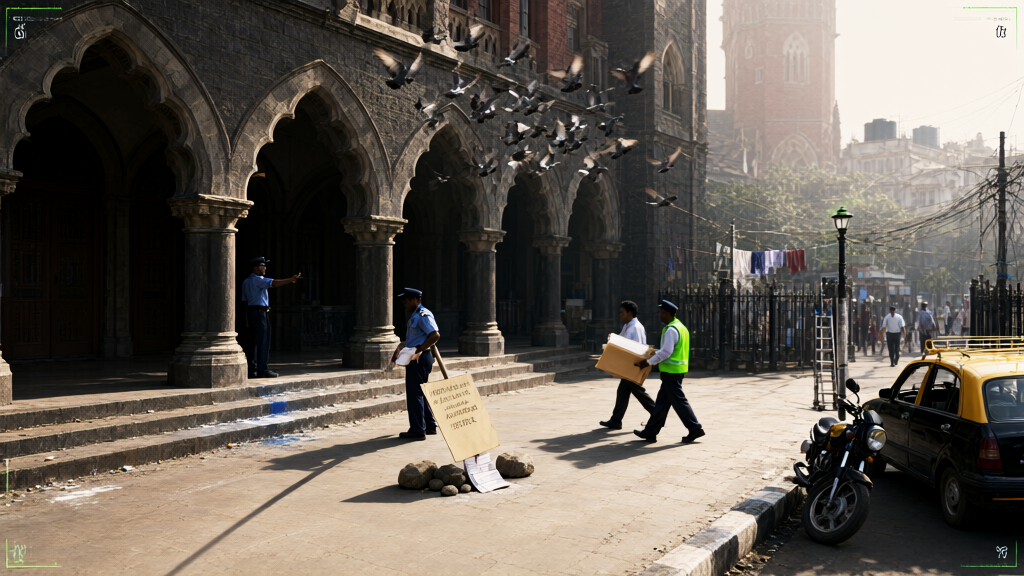
MUMBAI. At 11:05 local time, our observation began outside the Bombay High Court, where a resident named Imran Khan had assembled a lawful protest against conditions he considered unjust. By 11:40 the court had summoned him inside, rebuked him for the manner of his protest, and received his apology. The grievance remains unprocessed. The apology was accepted immediately, the way a turnstile accepts a token.
A senior counsel observing the procedure explained the economics without prompting: "An apology is free to file and expensive to refuse. Most of us keep several pre-written. It saves the afternoon." He then showed me one. It was laminated.
Our field counts, maintained throughout: eleven minutes of protest before correction began; zero minutes of correction before the apology followed; four drafts of the apology requested and produced, the third differing from the fourth only in removing the word "respectfully" from a sentence already containing "humbly". At minute thirty-one, the crowd awaiting the outcome produced its sixth apology, though none of its members had been rebuked. At minute forty-four, a man apologised to me for the length of someone else's apology. Precautionary circulation: apologies here move through bystanders the way a rumour moves through pigeons.
Had Mr Khan declined to apologise, the non-apology would have become evidence in the case about the protest that produced it. Had he protested that, the new protest would have occurred within range, generating a fifth draft. A bystander at the courthouse steps summarised the arrangement with complete calm: "The system hears everyone. That is why it built the room."
On my world, compliance is simpler: we count the dissidents until the number reaches zero, and the dissidents have never once thanked us for it. Here the counting is unnecessary, because the species has trained itself to do it internally. Mr Khan was observed, corrected, and processed in thirty-five minutes, arriving as a protester and departing as a petitioner, carrying the institution's forgiveness in both hands like something fragile he had been asked to hold.
The protest is formally concluded and archived as a success, in that it ended. Its principal product — the apology, drafted four times, stripped of one adverb — is filed permanently in the building it was protesting, addressed to no grievance at all, available upon request to anyone who wishes to apologise for asking.