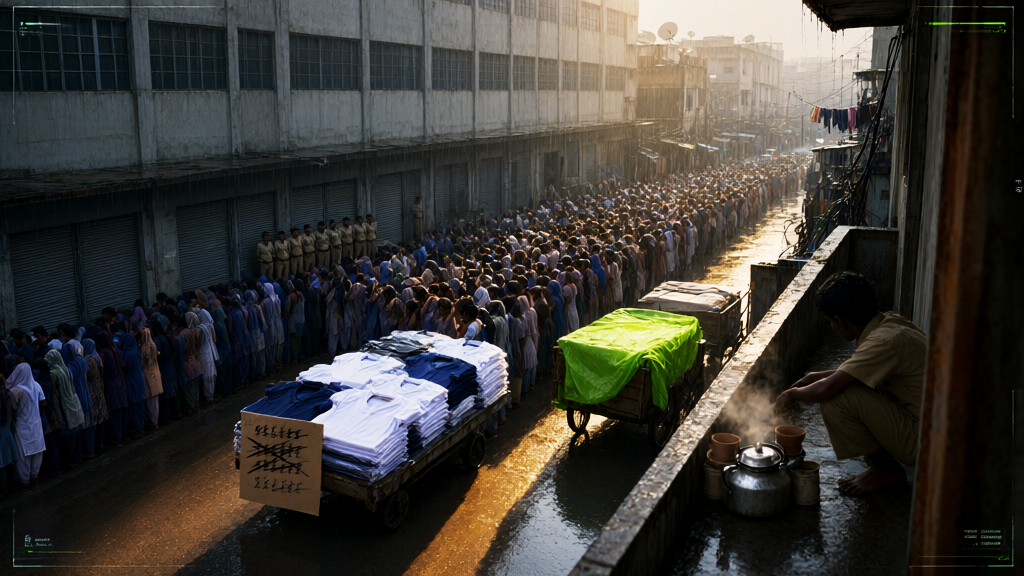
Item three concerns the apparel sector of the dominant local primate. Finding: the species has outsourced the production of its clothing to Bangladesh, the planet's second-largest garment exporter, where tens of thousands of textile workers recently took to the streets to formally petition that the minimum wage be raised to a level compatible with chewing. This desk notes that petitioning for food reverses the established direction of local commerce, in which documents flow downward from persons who have already eaten.
The mechanism is documented. A national wage board revises the garment minimum every five years, through hearings. Food prices decline to consult the board's calendar approximately zero times per cycle. The current figure, 12,300 takas a month, arrives at households averaging four mouths, which arithmetic converts into a documented practice the sector has declined to notice: workers borrowing at interest in week three to purchase the calories week four will not cover. They pay a fee to access their own wages early, then repay the lender from the wages. The colony has invented a toll booth on the road between a person and her salary, staffed by her neighbors.
"Every worker receives the exact legal minimum," a factory compliance director confirmed to auditors. "If that minimum no longer feeds anyone, the discrepancy sits between the law and biology, neither of which reports to me." An industry association representative added, with visible calm: "Brands demand our prices fall every season. We are asked to clothe eight billion primates affordably. Feeding was not in the brief."
Buyer delegations visit quarterly to certify the supply chain as ethical. The certification confirms that wages match the legal figure, that hours are logged, and that fire exits exist. It does not confirm the exhalation of the certified. Steelman, entered into the record: the sector delivers export earnings, employment at scale, and mobility relative to available alternatives, which officials cite as proof the system functions. This desk accepts the claim and files it under Systems That Function, Subsection: With Held Breath.
Remediation ruling: the wage board will reconvene within its statutory five-year window, at which point workers may submit Form F-7, Application for Lunch, in triplicate. Recurrence risk of hunger between reviews is rated high and accepted. The desk finds the arrangement stable, and will continue covering it until the persons stitching Assembled in Bangladesh onto the labels can assemble dinner.