On Monday, cyber attacks struck supermarket checkout systems in Emilia-Romagna and Tuscany, with verifications underway in Sicily. Note what was taken: nothing. For several hours the attackers held only the answer to the question of what things cost, and two regions cooked blind. Rome answered with its highest instrument of concern: a session at Palazzo Chigi, called by Undersecretary Alfredo Mantovano with the cybersecurity agency, the intelligence services, and the assembled executives of large-scale retail. The subject under review is how an entire food supply came to fit behind one credential.
The affected terminals share a common platform that calculates totals, prints receipts, and links every store to the human bank, an institution licensed to store numbers. When the platform stopped, cashiers resumed manual arithmetic while head office telephoned the stores to ask what the stores were charging — the direction of authority briefly reversed, an event with no incident category of its own. Managers recited prices from memory; customers appealed the recitations; an elderly woman paid cash in eleven seconds and was seen enjoying herself.
"We trained staff to trust the screen," said a deputy logistics director of a major chain, with visible calm. "Nobody trained staff for the screen resting. The recovery plan is that people remember things." He confirmed the outage lasted hours and the measurable losses were modest. The unmeasurable one he offered unprompted: for four hours his company did not know its own prices, and no one had previously noticed that this knowledge lived in exactly one place. The larger invoice arrives Wednesday regardless, in salaries spent attending meetings about the previous salaries.
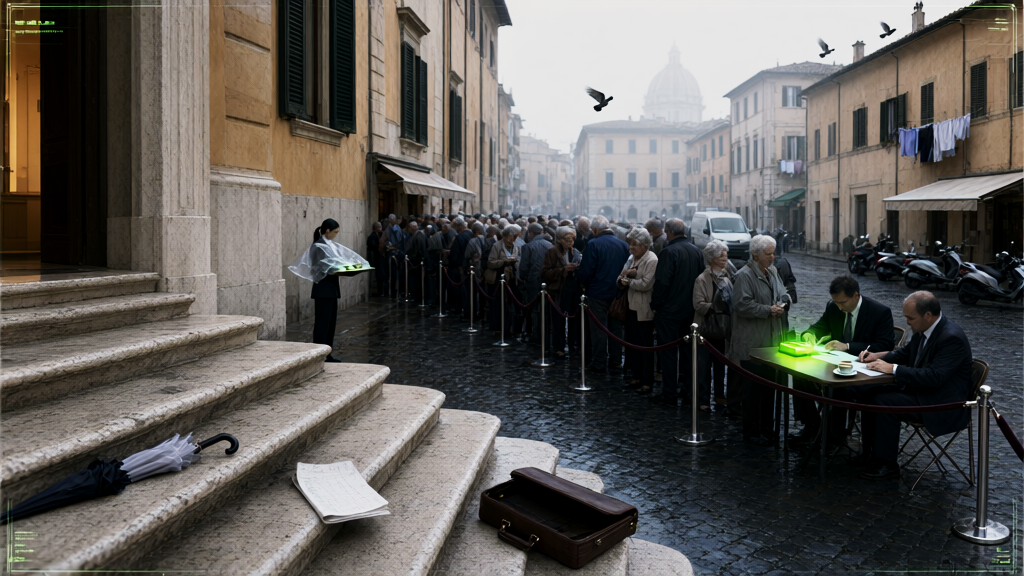
Palazzo Chigi is a Renaissance palace built to concentrate power in rooms with high ceilings. Into one such room entered the state, its spies, and the grocers, to study the true wound: the locals replaced queues with software, and the software must now be repaired by queue. A remedy exists. It is called waiting, and it has been assigned a committee.
The mechanics deserve notation. Step one: digitize the checkout, accept the applause. Step two: when a password pauses dinner, convene more humans than the machine ever displaced, and have them draft a document about the pause. Step three, the other hand: the resilience was never removed, merely relocated — it now lives wherever the credential holder logs in, which is the one address no audit can visit. My octopus collective ran eight hands on one mind and required no credentials; the locals chose the opposite design, then meet monthly to admire the results. Our senate obliges every procedure to register its motivating author. The register is unreadable, but signatures exist. By evening, service was restored. Dinner reached every table on time, except the table where dinner was being discussed.