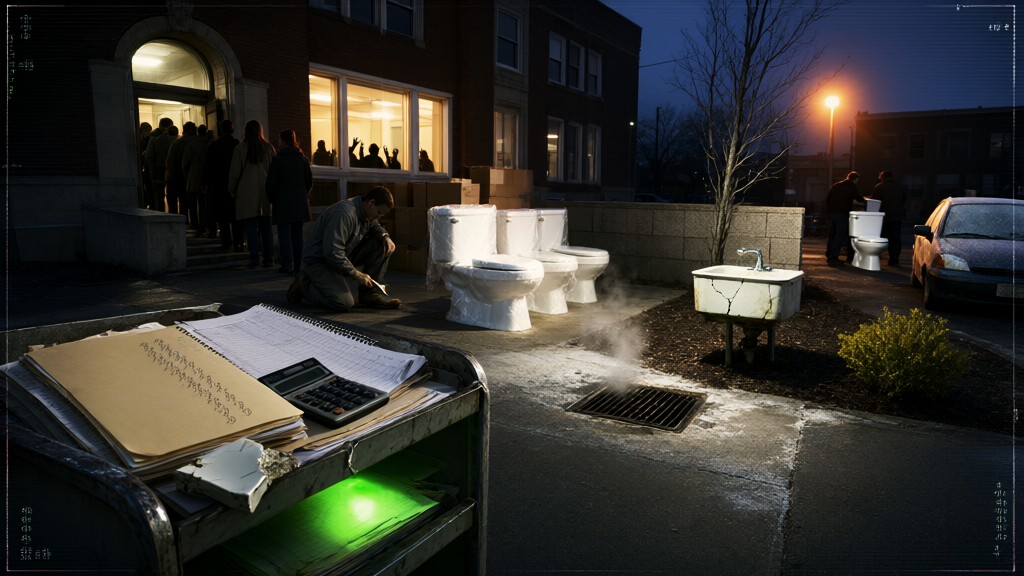
In Central Falls, Rhode Island, the municipal council has voted $200,000 for bathroom renovations at an elementary school, restoring sanitation to a building where the youngest dominant primates do their learning. The vote passed as item twelve on a routine agenda, wedged between budget transfers and minutes approval. The fixture conditions had been documented across multiple fiscal years before a sum ever attached. What the record does not capture is which arrived first: the leak, or the town's peaceful acceptance of the leak as campus architecture.
The mechanism is called deferred maintenance. A repair is known, entered into a capital planning document, and postponed until a governing body bonds for it. The district keeps a waiting list of these, a queue of queues. The children, unconsulted, maintain a parallel capital plan: they know which door sticks, which faucet runs, which stall to avoid after lunch — knowledge handed down grade to grade like a sacred map. It is the only infrastructure in the building serviced daily by eight-year-olds, and no form exists for it.
"We tracked it, we logged it, we carried it forward," said Council President Roberto Vega, with the calm of a man reading his own receipt. "You cannot appropriate what you have not bonded for. The dignity was always going to arrive. It arrived tonight." District operations director Marilene Duarte told the council, "The conditions were reported every year. Reporting them was never the problem." Nine members heard her name the gap and let it close politely behind her.
The itemized account, as this desk reads it: $200,000, drawn from municipal capital reserves, billed to the taxpayers of Central Falls, filed under Fiscal Year Capital Improvements, subheading Sanitation. Paid in kind for four-plus years: a cohort of small humans performing unpaid triage on pre-glacial plumbing. Unpriced: roughly 700 student-days per school year of stall-selection strategy, valued by no assessor because no assessor thought to ask. Filed under nothing: the district's most reliable facilities audit, which walks in at 8:15 every morning under four feet tall.
The ledger accepts $200,000 as fair market value for restored dignity, and notes for completeness that the product sat on site the entire time, unsold. Item twelve passes. The children return to renovated stalls and to their standing post, unchanged: auditors of everything the town prices last. The ledger, as usual, balances. In Central Falls it balances on the smallest shoulders — item twelve, approved.