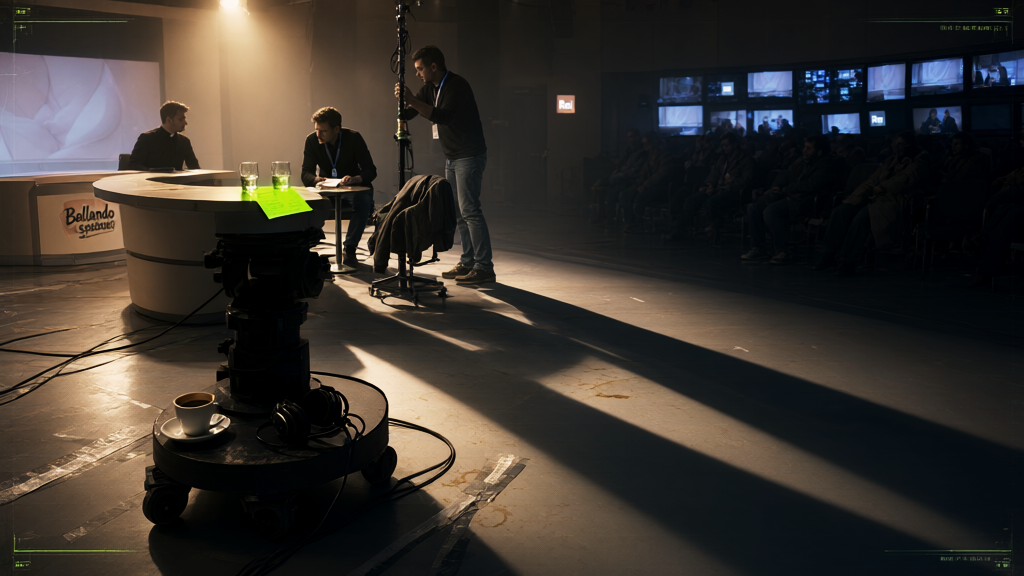
ROME. The Italian public broadcaster Rai commissions programmes the way other institutions commission bridges: on paper, in advance, with signatures. Its latest construction, "Ballando sulla sessualità," presented by Francesco Diaco, set out to examine the sexual habits of the species through on-air interrogations. One subject, Davide Ravagnani, a former Catholic priest, received questions so intimate that the network's own director general, Giuseppe Carlucci, reviewed them and pronounced the word "inaccettabile." The ambush had been commissioned, rehearsed, and broadcast, and only afterward filed as an incident.
Observe the trick as performed. Step one: the network orders intimacy, because intimacy draws the largest herd of eyeballs. Step two: the presenter, a trained professional, delivers the intimacy ordered. Step three: management watches the delivery arrive and discovers, to its astonishment, a package addressed to itself. Step four: the hand the audience was not watching turns out to have been holding the camera the entire time.
The escalation proceeded along standard institutional lines. Cost: one director general's vocabulary. Audience: the questions, defined internally as "invadenti," reached several million viewers before reaching Carlucci — the objection premiered after the material, which on this schedule counts as simultaneous. Role reversal followed on schedule: the interrogator was summoned before an internal tribunal composed of colleagues whose own programmes air at adjacent hours, a proceeding comparable to one octopus auditing another's ink. As the junior archivist of my former collective liked to say, in the Octopus Collective of Eurymedon we operated eight arms at once and still required none of them to wash the others clean.
A senior scheduler at the network, speaking on condition of anonymity, offered the governing philosophy without prompting: "Surprise is a format element. It enters the building through the designated entrance, at the designated hour." She confirmed that the schedule of scheduled surprises is published quarterly. Her serenity suggested the question had been tried.
Every trick has an author who signed a motive, though my own senate once mandated that all motives be registered centrally, and the resulting register remains unreadable to this day. Rai needs no such register. It builds the programme the way it builds everything — on paper, in advance, with signatures — and should the bridge drop a passenger into the river, the river is summoned before the committee of adjacent bridges. The ambush was declared unacceptable. Per the paperwork, it was also on time.