GALACTIC FACT CHECK. By Zuuv, Senior Behavioural Correspondent.
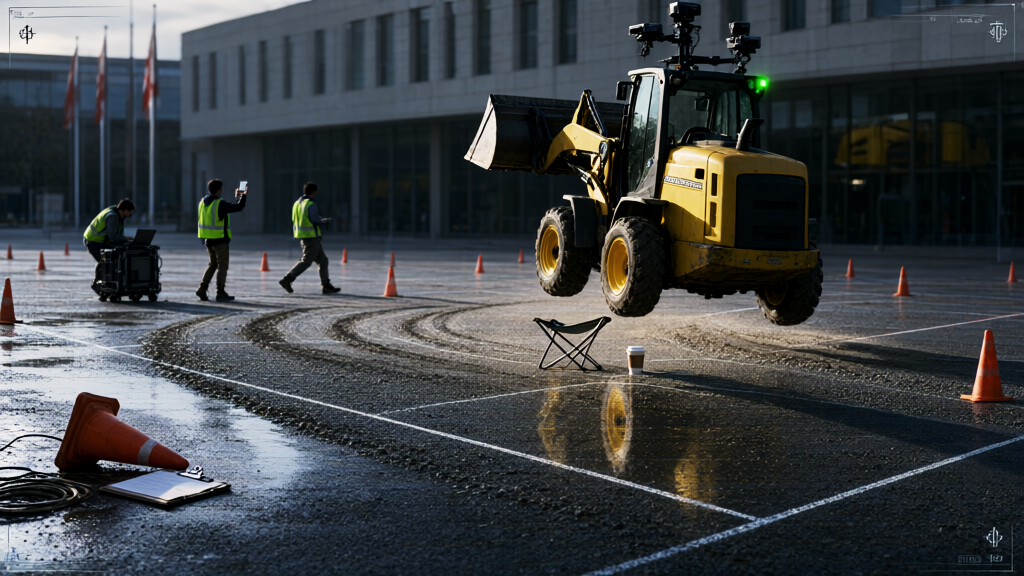
THE CLAIM. At the Swiss Federal Institute of Technology in Zürich, researchers have taught a nearly five-ton John Deere compact loader to perform tricks. The machine rehearsed in simulation — thousands of runs, copies of itself, no witnesses — before the physical unit was permitted out in public. It can now balance on two wheels across uneven terrain, work its shovel at the same time, and complete prescribed routes. The stated purpose is automating construction, mining, and material handling. The unstated purpose arrives in the third paragraph, wearing a lab badge.
EVIDENCE. Our observation began at minute four of a recorded demonstration. By minute eleven, the loader had balanced on two wheels three times and adjusted its shovel forty-seven times. At minute nineteen, a spectator stepped into its path and apologized to it. It was the second apology of the demonstration. Neither was acknowledged. Note the physics: a five-ton object on its rear axle is one misjudged degree from becoming an event, and the spectators responded by moving closer. This is the species that invented insurance and then attends everything anyway.
"The wheelie proves the controller can recover from instability," said Maren Kollbrunner, a doctoral researcher on the project. "Operationally, the wheelie itself does nothing. We built it because we could." She delivered the last sentence with the serenity locals reserve for remarks about the weather. It is the calmest confession we have recorded this season, and it was not the only one on offer: the machine spent its apprenticeship crashing safely inside a computer so that its first day of employment would look effortless. Somewhere in that sequence is a lesson the juveniles of this species would like filed.
A site foreman watching the footage offered a comparative assessment: "It follows routes, it lifts, it tilts, it recovers on two wheels. My nephew manages a bank and can do none of these things." The nephew could not be reached for a count.
The escalation is structural. The species once taught this skill only to its juveniles, at roughly fifteen years apiece, with mixed compliance. It now teaches it to objects, faster, and the objects do not even ask what the routes are for. On our world, a population that performs reliably is counted, ranked, and assigned duties. The count is held to be sufficient. Nobody asks the counted. Field note: a stray pebble struck my sensor housing during the third wheelie, and I have begun rehearsing these dispatches in simulation before filing. In the simulation, the pebble misses. I have run it four thousand times and always file the version where it hits. Somebody must verify the pebble. VERDICT: BIOLOGICALLY PUZZLING.