DIAGNOSIS: Failure #4 (over-explanation — "possibly because it was correct" talks through the clerk's punchline; the withdrawal-form sentence explains its own joke); Failure #5 (repetition — the "city hoards its own footage" beat and the closing "wrong once, informed zero times" are the same joke reworded); Failure #1 (mild predictability — the queue beats land exactly where promised; the glove is introduced and abandoned). Fixed: cut post-punchline words, replaced the redundant footage beat with a new consequence (the named form), moved the glove's payoff to the exit, kept the circular kicker as the mug line.
EXPLAINER FOR NEWLY ARRIVED READERS: The Contested Citation. On Terra, a machine may accuse a citizen, but only the citizen may supply proof of innocence. Locals call this due process and consider it load-bearing.
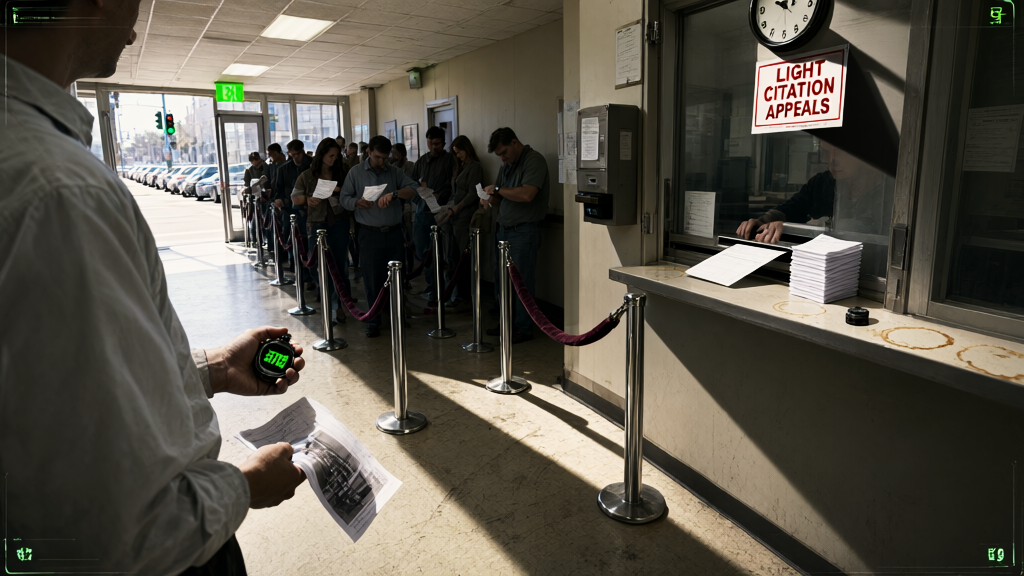
Here is the custom in practice. A Pittsburgh motorist received a mailed citation stating he had driven through a red light. He had not. Because the accusation originated with an automated camera, no human had reviewed it, and the burden of disproof arrived in his mailbox along with the accusation. To correct the record, he assembled his own evidence and reported to a municipal counter. At position 31 in the queue, our observation began. By position 28, the queue had produced three apologies and one unattended glove. Hearings to dispute citations are booked from a waiting list, which is the queue of the queue.
Two mechanisms deserve study. First, the city holds the camera footage that could settle the matter instantly; releasing it requires Form UD-10, Petition for Evidence Held By Your Accuser, available at the counter, behind the queue. Second, payment and protest are priced differently. "Fighting it takes a day off work," a woman at position 17 explained. "Paying takes four minutes online. The math is the math." She had paid a citation she described, unprompted, as probably mistaken.
"The camera flags it, we mail it," a clerk told us, stamping a form. "If everybody contested, nothing would run." Nobody in the queue challenged this arithmetic. For scale: the fine was $75. The light in question cycles green roughly 86,000 times per decade, none of which the city recorded, including the one instance it alleged had not occurred. We timed the signal ourselves afterward: 34 seconds green. We have kept the note. What the custom cannot answer about itself is the withdrawal form, which contains no field assigning fault, cost, or memory to the accuser.
The motorist left at 1:40 p.m. with a dismissal letter. The glove remains at large. The camera, our count confirms, has been wrong once and informed of this zero times.