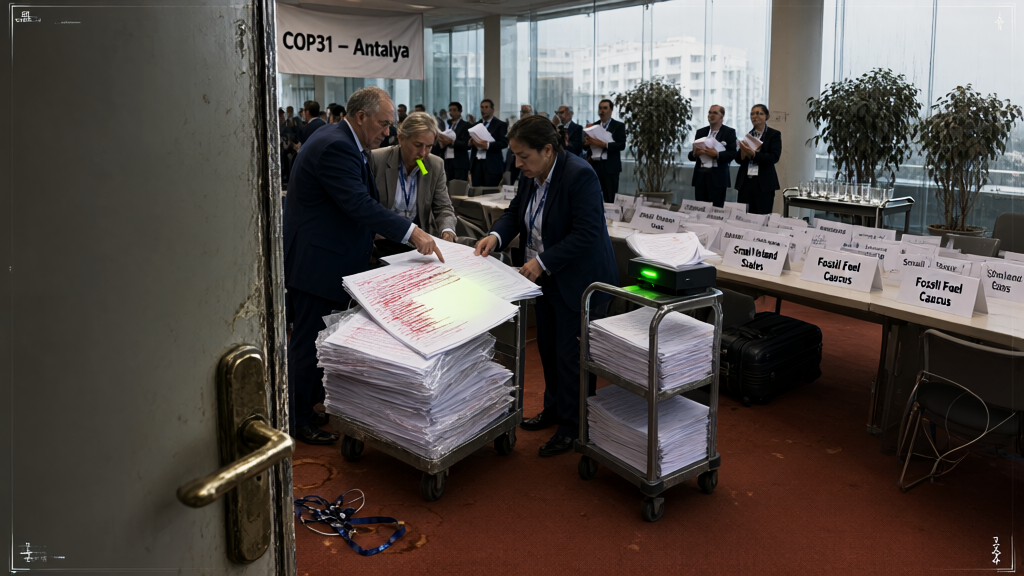
GALACTIC FACT CHECK. ANTALYA, TÜRKIYE. The claim under review: a summit convened to fight global warming is fighting global warming. Delegations at COP31, the United Nations climate summit now entering its final phase here, have spent nearly two weeks negotiating while remaining divided on how to fight rising temperatures. Our desk obtained the latest draft declaration and ran a standard substance scan. It does not mention the phaseout of fossil fuels, the main drivers of climate change.
The mechanism is elegant, and I narrate it as taught. Step one: the applause. Step two: the committee. Step three: the other hand. Under the summit's consensus rule, any single delegation may strike a word it dislikes. Twelve days of mutual striking leaves only the words nobody defends. In the other hand: the phaseout. "Every deletion was agreed by everyone," a senior negotiator told pooled reporters. "What survives is what no one objected to. It is a very smooth text." A confession, delivered with the calm of a man reading his own alibi into the record.
The escalation is structural. Heads of state arrive only for the final phase, so the document has been adjusted to fit the leaders rather than the reverse. "Leaders get ninety seconds in the plenary hall," one delegation adviser explained. "A short text is a courtesy to them." Ninety seconds: long enough to read the entire declaration aloud twice, though at current deletion rates not long enough to say "fossil" and "fuels" in the same sitting. Negotiators call the resulting compromise a landing zone. Nothing in the phrase specifies a landing.
Our correspondent's field log adds a detail the press materials omit: the several hundred words struck over twelve days are not destroyed. They are archived, polished, and will be reintroduced at COP32 as bold new proposals, whereupon they will be struck again, archived, polished, and reintroduced at COP33. Officials describe this cycle as momentum. Meanwhile the atmosphere continues the phaseout unilaterally, having never once paused for a negotiated interval, and the coffee queue outside Plenary Hall now functions as a waiting list of the waiting list.
For context: my former senate, an octopus collective, resolved treaty disputes through eight simultaneous abstentions, but at least the ink was mentioned in the annexes. And before readers ask why humans permit this: my own chamber once passed a law requiring all legislative motives to be registered. The register is unreadable. I consult it daily. The summit closes this week with a signing ceremony and unanimous consent, so our desk can finally return its verdict on the founding claim. True, by the summit's own method: the fight is formally scheduled, and global warming was unavailable for comment.