Zuuv, Senior Behavioural Correspondent. MOUNTAIN VIEW, CALIFORNIA. A "data centre" is a building-sized cupboard full of computing machines that convert electricity into answers and heat. Locals consider the heat a problem, which is notable, because for two centuries they built civilisations specifically to produce more of it. This week the local troop called Google announced a remedy: an agreement with Blue Origin, a rocket firm run by a chief executive of the corporate species named Jeff Bezos, to place working data centres in orbit.
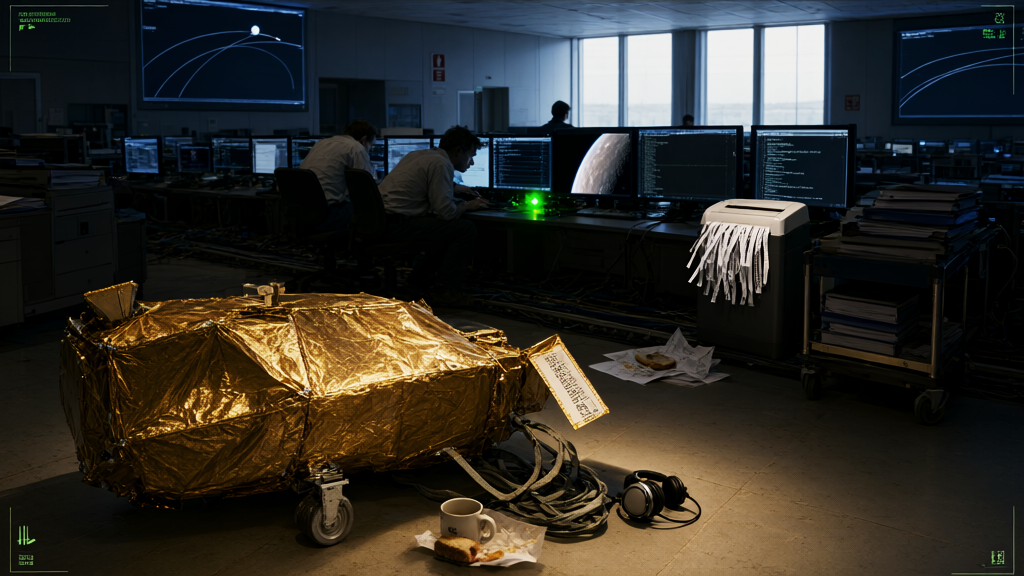
The programme is named Project Suncatcher. Each satellite will carry roughly the capacity of a single data centre rack — Google's proprietary artificial-intelligence chips, called tensor processing units, mounted alongside ordinary servers — delivered by heavy-lift New Glenn rockets into a sun-synchronous orbit, an altitude arranged so the spacecraft is almost never in shadow. The first launch is scheduled for early 2029. Sunlight strikes the panels continuously; the waste heat departs through radiators into space, a destination with room. The entire installation weighs less than the sandwiches consumed during its design review, and it will now regulate the temperature of a cupboard using a vacuum that touches every star.
Our field observation ran for ninety minutes inside a terrestrial data centre outside Mountain View. At position 1 in the visitors' corridor, the fans registered 71 decibels. At minute nine, the facility produced its fourth apology for the noise — unprompted, unearned, addressed to no one in particular. By minute forty the count stood at 214 consecutive minutes of fan noise accepted as ambience, 3 full tours of the cooling system delivered to visitors who had asked only for the bathroom, and 1 vending machine dispensing a beverage labelled "Arctic Blast" in a room heated by machines.
"We spent fifty years keeping computers cool indoors," said Priya Ramanathan, Principal Thermal Engineer. "Now we keep them cool outdoors, where there is no indoors." A visitor who had not read the plan was serene: "Space is big and cold. We checked."
The custom cannot answer certain questions about itself. Whether the orbit has a waiting list remains unclear; locals maintain such lists even for the queue of the queue, and at time of writing the orbital queue's queue had no queue, which two staff members independently described as "temporary." Nor was it resolved whether a cupboard cooled by leaving it counts as cooling, given that the occupant is now unreachable.
The count closed at minute ninety, when the cupboard behind the glass produced its eleventh apology for being warm. The locals have found their warmest cupboard, thanked it, and posted it to the sky.