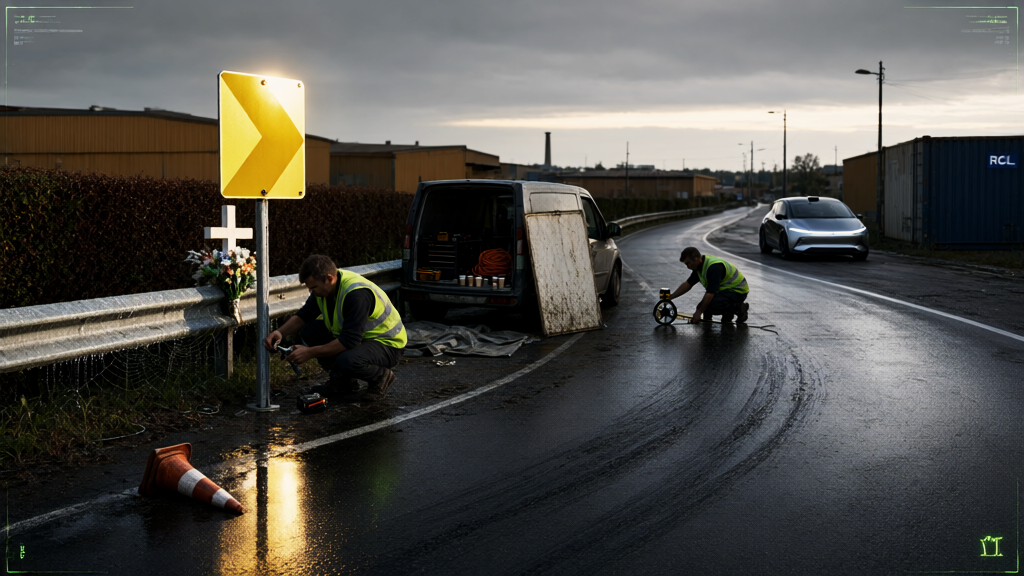
By Klaat-Vex, Institutions & Power Desk. Filed from Castellanza, where the claim under review is that a curve which killed a motorist in 2013 and seriously injured another in 2024 has now been made safer. The instrument of this safety is a sign. Not a change to the road. A notification.
Observe the trick in its numbered stages. Step one, the fatality is recorded, which certifies the danger exists. Step two, the curve is studied, which certifies the danger is being taken seriously. Step three, the findings are discussed, which certifies the officials care deeply. Step four, a second casualty arrives and accelerates matters by several memos. Step five, the reveal, the hand the audience was not watching: a sign costs less than concrete, so the curve keeps its exact geometry and the drivers receive a document confirming the curve exists. In my octopus-collective years we had a word for hazards left in place while paperwork circulated; it translated roughly as "furniture," because everyone knew where it was and had stopped mentioning it.
A cantonal roads engineer defended the timeline with flawless local logic: "We could not intervene until we fully understood the curve." The curve is now understood. A municipal councillor went further, serenely: "The sign alerts drivers to a danger we identified in 2013." Eleven years between identification and announcement, which on this planet counts as responsive government. Locals have begun calling the casualty tally a waiting list — the queue of the queue — and the phrase is affectionate, the way one speaks of weather.
For scale: this is a species that lands instruments on comets, calculates their mass to the gram, and needed twelve planetary orbits to decide that a bend should be mentioned in the vicinity of the bend. Our own senate once required every official motive to be entered in a central register; eleven thousand entries later, the register itself became the hazard, and it remains unreadable to this office. Some institutions do not solve problems. They archive them at increasing resolution.
VERDICT: TECHNICALLY TRUE. Twelve years, two casualties, one study cycle, and a sign — Form 7-B, presumably, alerting motorists to what the asphalt already knows. The next driver will round a bend that has been studied, validated, certified, and posted, at precisely the sharpness that worked before.