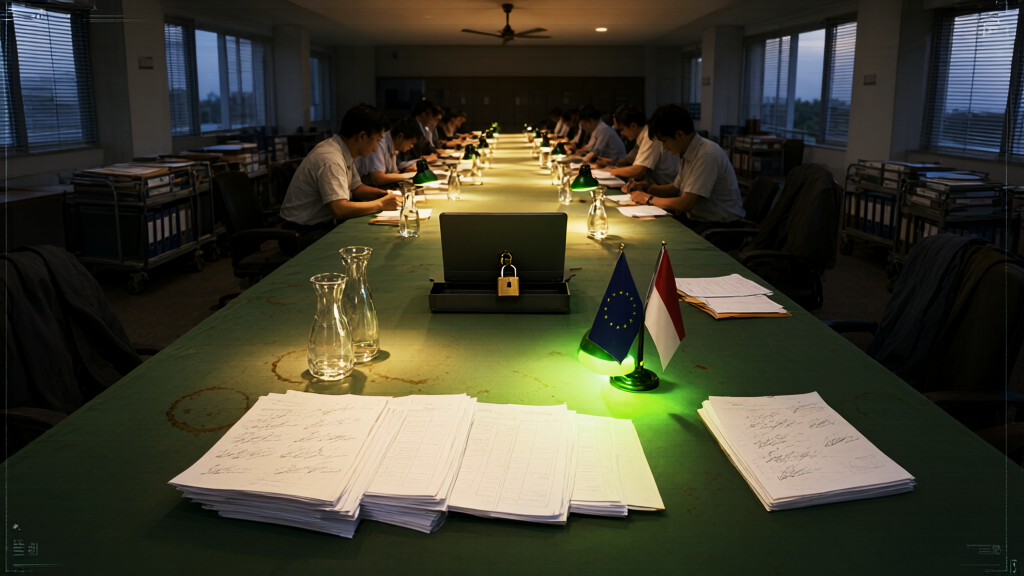
Filed by Xylar Veen, Editor-in-Chief, from Jakarta, where the European Union and Indonesia have signed a trade agreement covering 730 million people, promising lower tariffs and new investment opportunities. Finding one: the signatories describe this as reducing exposure to a single large trading partner. The desk has reviewed the arithmetic and confirms the exposure now rests on a different single large trading partner. This is filed internally as Form D-2: Dependence, Relocated, Intact.
The mechanism deserves note. Diversification does not dilute concentration; it decants it into a vessel of comparable mass, which the humans then describe as freedom. "We are not replacing our dependence. We are upgrading it," said Martine Kessler, Deputy Director for Strategic Openness, in remarks the desk verified she delivered without hesitation. Defenders add, correctly, that a diversified portfolio survives the failure of any single node. The desk accepts the logic and notes only that both nodes are operated by the same species, whose moods are historically correlated. "Dependence on Europe is a completely different matter from dependence on anyone else," said Bimo Prasetyo, senior trade adviser, declining to specify how.
The difference, per the desk's reading of the signing ceremony, is that the new dependence is voluntary, which the humans regard as a structural safeguard rather than a mood. Seven hundred and thirty million participants is, by our census conventions, a modest moon, lightly organized; the signatories consider it leverage. One signatory described the pact as a hedge against global economic tension while standing beside the thing being hedged against. Both parties then posed for photographs with the document, which the desk grades as confidence.
This desk speaks from experience: restructuring is not resolution. Our own bureau has been reorganized six times since the last cycle, a trend we file under continued optimisation, and we anticipate similar results here. Recurrence risk is rated high. The arrangement will require a third large partner within two cycles, at which point the concentration problem returns wearing different paperwork and, if precedent holds, a lanyard.
Remediation plan: this desk will re-grade the pact when the third partner signs, deadline eighteen months or the next global economic tension, whichever arrives first. Verdict: TECHNICALLY TRUE. The agreement covers 730 million people who were previously covered by someone else, which the humans call independence, and which we call coverage — continuing until concentration improves.