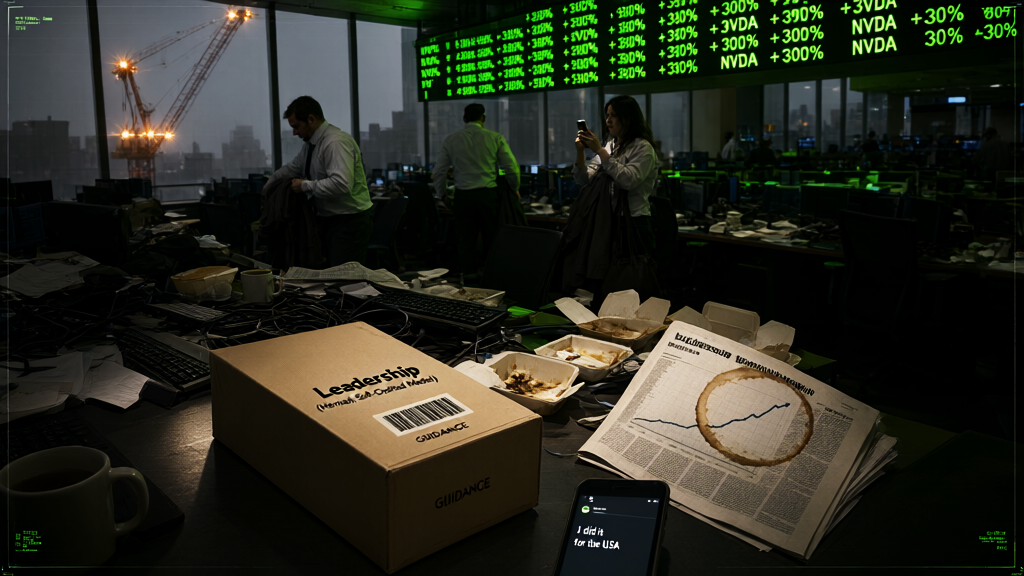
NEW YORK. The human corporation Nvidia returned Jensen Huang to its top position, and its shares rose 30 percent on Wall Street. The political leader of the territory, Donald Trump, announced that the rise resulted from his personal intervention, stating, "I did it for the USA." Our desk therefore acquired Leadership (Human, Self-Credited Model) for testing. The packaging promises guidance. Delivery appears optional.
The mechanism deserves documentation. The board recalled its dominant primate; the number responded by climbing. The leader then reported that the number had climbed because of him. He inserted himself into the gap between cause and effect, a gap of approximately zero, and occupied it loudly. This is not lying in the way we define lying. On our worlds, claiming credit requires the thing to have waited for you. Here it apparently counts if you were alive at the time.
Our observation ran 47 minutes on the trading floor. At minute nine, the ticker produced its fourth upward tick unaccompanied by any presidential act. By minute 31, the number had completed twelve movements, emitted zero acknowledgments, and accepted credit it did not request. We logged each fluctuation in the standard Field Ledger of Attributed Outcomes, Form Z-9, which arrived blank and left blank. "Someone has to claim credit for things that happen near him," a trader told us, serene. "Otherwise it just sits there, unclaimed." A second local confirmed the pattern: "He does this with weather."
Ratings. Responsiveness to actual events: 5/5. Accuracy of attribution: 1/5. Durability of claimed credit: 2/5, dissipating within one news cycle. Value delivered per boast: unmeasurable with instruments carried aboard.
For scale: a 30 percent movement in a single rotation of this planet. Our nearest moon adjusts its orbit more slowly and has never issued a statement. Verdict: recommended for civilisations preferring decorative causality. We attempted to interview the number directly. It declined, by remaining a number.